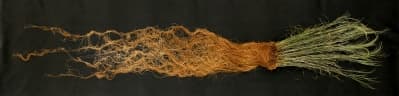
Panicum virgatum
Panicum virgatum
Safety & Hazards
None known
Cultivation Details
Panicum virgatum is a plant, originally of the temperate zone, that has spread into the subtropics and tropics. It grows best in areas where annual daytime temperatures are within the range 17 - 32°c, but can tolerate 6 - 36°c[1]. It can be killed by temperatures of -10°c or lower, though new growth can be damaged at -1°c[1]. It prefers a mean annual rainfall in the range 500 - 1,100mm, but tolerates 350 - 2,700mm[1]. Grows in any moderately fertile, well-drained soil in a sunny position[2]. A drought resistant plant, it is easily grown in average to wet soils and in full sun to part shade[1]. Prefers a pH in the range 6 - 7, tolerating 4.9 - 8.2[1]. Plants have particularly heavy growth in late spring and early summer[3]. The plant has the potential to produce the biomass required for production of up to 380 litres of ethanol per metric ton. This gives it the potential to produce over 400 litres of ethanol per hectare, compared to 270 for sugarcane and 160 for corn. However, there is debate on the viability of switchgrass, and other bio-fuels, as an efficient energy source. University of California, Berkeley professor Tad Patzek argues that switchgrass has a negative ethanol fuel energy balance, requiring 45% more fossil energy than the fuel produced[1]. The plant photosynthesize by a more efficient method than most plants. Called the 'C4 carbon-fixation pathway', this process is particularly efficient at high temperatures, in bright sunlight and under dry conditions[1]. As an open pollinated species, switchgrass expresses tremendous genetic diversity, with wide variations in its basic chromosome number (2n = 18), typically ranging from tetraploid to octoploid. Morphologically switchgrass in its southern range can grow to more than 3 m in height, but what is most distinctive is the deep, vigorous root system, which may extend to depths of more than 3.5 m[1].. It reproduces both by seeds and vegetatively and, with its perennial life form, a stand can last indefinitely once established. Standing biomass in root systems may exceed that found aboveground, giving perennial grasses such as switchgrass, an advantage in water and nutrient acquisition even under stressful growing conditions[1].
Propagation
Seed - sow spring in a greenhouse and only just cover the seed. Germination should take place within a week. Prick out the seedlings into trays or individual pots and plant them out after the last expected frosts[2, PFAF]. Division in spring. Very easy, larger divisions can be planted out direct into their permanent positions. We have found that it is better to pot up the smaller divisions and grow them on in light shade in a cold frame until they are well established before planting them out in late spring or early summer. Cite as: Temperate Plants Database, Ken Fern. temperate.theferns.info. 2026-02-21. <temperate.theferns.info/plant/Panicum+virgatum>
Pollinators
Wind
References
- [1]Ecocrop — http://ecocrop.fao.org/ecocrop/srv/en/home ↩︎Basic information on a wide range of useful plants, plus details of environmental needs where available.
- [2]The New RHS Dictionary of Gardening. 1992. — Huxley. A. · MacMillan Press · 1992 · ISBN 0-333-47494-5 ↩︎Excellent and very comprehensive, though it contains a number of silly mistakes. Readable yet also very detailed.
- [3]The National Non-Food Crops Centre Crop Database — http://www.nnfcc.co.uk/crops/pd.cfm ↩︎An excellent on-line information source, with information on over 100 species (as of 2006) of plants being investigated as bio-crops.
- [4]Flora of N. America — http://flora.huh.harvard.edu/fna/ ↩︎An on-line version of the flora with an excellent description of the plant including a brief mention of plant uses.
- [5]Pacific Island Ecosystems at Risk — http://www.hear.org/pier/scientificnames/index.html ↩︎A very good website detailing weed species that have been introduced into the Pacific Islands.
- [PFAF]Plants for a Future — pfaf.org ↩︎