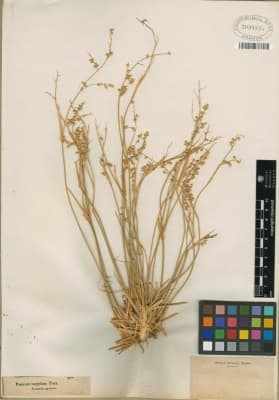
Panicum turgidum
Panicum turgidum
Safety & Hazards
None known
Cultivation Details
A plant of the arid tropics and subtropics where it is found at elevations up to 3,200 metres[1]. The plant grows best in areas where the mean annual temperature is within the range 25 - 35°c, but can tolerate 8 - 40°c[1]. It prefers a mean annual rainfall in the range 200 - 400mm, tolerating 100 - 600mm[1]. Requires a sunny position and a very well-drained soil[1]. Prefers a light to medium soil and is tolerant of poor soils and saline soils[2, 1]. The plant is extremely drought resistant[3]. Prefers a pH in the range 6.5 - 7, but tolerates 6 - 8[1]. In dry areas the dormant buds sprout rapidly after the onset of the rainy season and the plants stay green over a very extended period, with flowering occurring towards the end of the rainy season and during the early part of the dry season[2]. The seeds are difficult to harvest in quantity because they mature at different times over an extended period, shatter easily and are often eaten by birds[2]. The plant photosynthesize by a more efficient method than most plants. Called the 'C4 carbon-fixation pathway', this process is particularly efficient at high temperatures, in bright sunlight and under dry conditions[2]. A collection of 42 accessions of Panicum turgidum is held at the International Livestock Research Institute (ILRI), Addis Ababa, Ethiopia. High grain-yielding types are particularly found in the Middle East[2].
Propagation
Seed - it does not germinate below 15°c[2]. Surface sow, or only just cover, in a very well-drained medium but ensure the seed does not dry out. Germination is best at 25 - 35°c[2]. Transplanting of seedlings is possible[2]. Natural reproduction of Panicum turgidum is mainly vegetatively by stolons[2]. Division of self-layered plants[PFAF]. Cite as: Tropical Plants Database, Ken Fern. tropical.theferns.info. 2026-02-20. <tropical.theferns.info/viewtropical.php?id=Panicum+turgidum>
Pollinators
Wind
References
- [1]Ecocrop — http://ecocrop.fao.org/ecocrop/srv/en/home ↩︎Basic information on a wide range of useful plants, plus details of environmental needs where available.
- [2]Protabase - Plant Resources of Tropical Africa. — http://www.prota.org ↩︎An excellent on-line database with detailed information on over 3,200 species of useful plants of Africa.
- [3]The Useful Plants of West Tropical Africa. — Burkil. H. M. · Royal Botanic Gardens; Kew. · 1985 - 2004 ↩︎Brief descriptions and details of the uses of over 4,000 plants. A superb, if terse, resource, it is also available electronically on the Web - see http://www.aluka.org/
- [PFAF]Plants for a Future — pfaf.org ↩︎