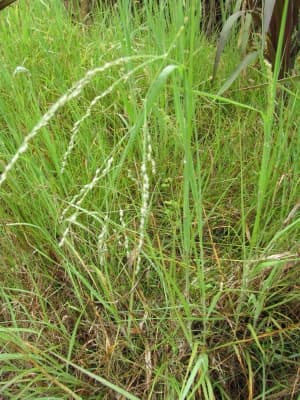
Panicum coloratum
Panicum coloratum
Safety & Hazards
None known
Cultivation Details
A plant of the tropics and subtropics, where it is found at elevations up to 2,100 metres. It grows best in areas where annual daytime temperatures are within the range 17 - 26°c, but can tolerate 8 - 35°c[1]. When dormant, the plant can survive temperatures down to about -10°c, but young growth can be severely damaged at -1°c[1]. The plant is susceptible to frost but usually recovers[1]. It prefers a mean annual rainfall in the range 500 - 1,700mm, but tolerates 400 - 2,600mm[1]. Requires a sunny position[1]. Succeeds in most reasonably fertile soils[1]. Tolerant of saline soils[1]. Prefers a pH in the range 5.5 - 6.5, tolerating 5 - 7.5[1]. It is drought tolerant by virtue of its deep fibrous root system, and is able to grow on flood plains (where soil moisture is comparatively long-lasting)[1]. The plant is able to survive annual burning[2]. Panicum coloratum is generally slow to establish, competing relatively poorly with weeds and other pasture species during early growth[2].
Propagation
Seed - it can have high levels of dormancy that can last from 3 - 6 months in var. coloratum and up to 3 years in var. makarikariense. Germination can be improved by removal of the glumes[2]. Seed can be broadcast on the surface or sown in rows using a sowing rate of 2 - 4 kilos per hectare. Although seedlings can emerge from seed placed to 10cm in lighter soils, it is safer to sow at 1 - 2cm[3]. Rolling after sowing improves establishment. Rolling before sowing to compact the seedbed can also be valuable in heavier soils, which have less tendency to crust if rolled prior to broadcasting and lightly covering the seed with harrows[2]. Cite as: Tropical Plants Database, Ken Fern. tropical.theferns.info. 2026-02-20. <tropical.theferns.info/viewtropical.php?id=Panicum+coloratum>
Pollinators
Wind
References
- [1]Ecocrop — http://ecocrop.fao.org/ecocrop/srv/en/home ↩︎Basic information on a wide range of useful plants, plus details of environmental needs where available.
- [2]Tropical Forages — http://www.tropicalforages.info/key/Forages/Media/Html/index.htm ↩︎Mainly focussed on forage plants, the site gives a lot of information on the plant, with a good botanical description, details of cultivation, plant uses and a good selection of photographs.
- [3]Annals of the Missouri Botanical Garden. Volume 55 — Missouri Botanical Garden · 1968 · http://www.biodiversitylibrary.org ↩︎Contains, amongst other things, a taxonomic treatment of the Phytolaccaceae and part of the flora of Panama. Can be downloaded from the Internet.