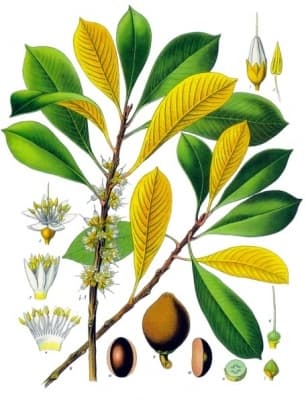
Palaquium gutta
Palaquium gutta
Safety & Hazards
None known
Cultivation Details
Gutta percha is a plant of mainly lowland areas in the moist tropics, with or without a dry season, though it can be found at elevations up to 1,600 metres[1]. It grows best in areas where the mean annual temperature falls within the range 24 - 30°c, but can tolerate 17 - 38°c[1]. It prefers a mean annual rainfall in the range 2,000 - 3,000mm, tolerating 1,500 - 4,000mm[1]. Prefers a sunny position[1]. Grows best in a deep, fertile, well-drained soil[1]. Requires a loose and well aerated soil rich in organic matter[2]. Prefers a pH in the range 6 - 7, but tolerates 5.5 - 8[1]. In Peninsular Malaysia, trees have a mean annual diameter increment of 1.2 cm and attain a height of about 8 metres in 7 years, 17 metres in 23 years and a diameter of about 50 cm in 50 years[2]. Higher latex yields are obtained by tapping the upper portion of the trunk and branches than by tapping the lower part[2]. Yields of gutta-percha per tree are also very variable. About 1.5 kg was reported to be a good average yield for destructive harvesting. The latex yield obtained by tapping living trees is much lower. The approximate gutta-percha yield per ha was 450 kg (2.3% from treated leaves) in 1920; a recent estimate from the company exploiting the Cipetir plantation was only 20 kg/ha annually, probably because of the extensive way of exploitation nowadays[2].
Propagation
Seed - best sown as soon as it is ripe since it loses its viability within 2 - 8 weeks[2]. Fresh seed has a germination rate of 75 - 85%[2]. Seed should be sown in deep nursery beds, as the seedlings quickly develop a strong taproot[2]. Young plants need shade and plenty of water, they grow quite rapidly and are ready for planting out when about 25 cm tall[2]. Mortality after planting out is usually high at up to 35%[2]. Cite as: Tropical Plants Database, Ken Fern. tropical.theferns.info. 2026-02-20. <tropical.theferns.info/viewtropical.php?id=Palaquium+gutta>
Pollinators
Data unavailable
References
- [1]Ecocrop — http://ecocrop.fao.org/ecocrop/srv/en/home ↩︎Basic information on a wide range of useful plants, plus details of environmental needs where available.
- [2]Plant Resources of Southeast Asia — http://proseanet.org/ ↩︎Lots of information on the uses of the plants of SE Asia.
- [3]Flora of Peninsula Malaysia — http://www.tfbc.frim.gov.my ↩︎In the process of being assembled (15/07/09), it is currently a series of check sheets giving species name, brief description, habitat and high quality photos of the plants.
- [4]Mansfeld's Database of Agricultural and Horticultural Plants — http://mansfeld.ipk-gatersleben.de/pls/htmldb_pgrc/f?p=185:3:4292127278597336 ↩︎Terse details of a huge range of useful plants.
- [5]IUCN Red List of Threatened Species — http://www.iucnredlist.org/ ↩︎A list of plants under threat and facing possible extinction, usually with brief details of the threats and information on habitat.
- [6]Dictionary of Economic Plants. — Uphof. J. C. Th. · Weinheim · 1959 · ISBN - ↩︎An excellent and very comprehensive guide but it only gives very short descriptions of the uses without any details of how to utilize the plants. Not for the casual reader.
- [7]Asean Tropical Plant Database — http://211.114.21.20/tropicalplant/index.jsp ↩︎Terse details, with photos, of many of the plants growing in the tropical forests of southeast Asia. Gives some details of plant uses along with a description of the plant and its range.
- [8]Tropix 7 — CIRAD · http://tropix.cirad.fr/en ↩︎An on-line guide to the timbers of 245 species of trees.
- [9]A Dictionary of Malaysian Timbers — Wong T.M. · Forest Research Institute Malaysia; Kuala Lumpur · 2002 · http://Elaeocarpaceae · ISBN 983-2181-29-1 ↩︎A fairly comprehensive guide to Malaysian timbers, giving their properties and the main tree species from which they are obtained.