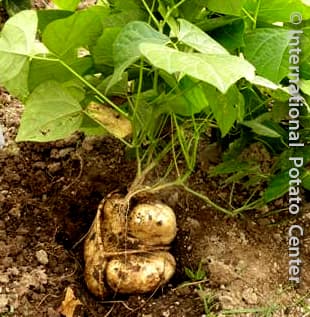
Cultivation Details
Grows well in lowland tropical areas at elevations up to 1,000 metres and a moderate rainfall[1]. Plants grow best in areas where the mean minimum temperature is 25°c and the maximum is 30°c, though it can tolerate 16 - 34°c[2]. It prefers a mean annual rainfall in the range 1,500 - 1,900mm, but can tolerate 640 - 4,000mm[2]. Prefers a sunny position[2]. Tolerates a wide range of soils[1]. Prefers a light, rich, well-drained, sandy soil[3, 1]. Dislikes water-logged soils[1]. Prefers a pH in the range 5 - 5.5, but can tolerate 4.3 - 7.3[2]. The tubers mature in 180 - 240 days[2]. A short-day plant, it requires between 11 - 13 hours of daylight hours per day in order to initiate tuber production[PFAF], though vegetative growth is normal even in relatively long days of 14 - 15 hours[1].. When grown for its root the flowers should be removed[3]. This species has a symbiotic relationship with certain soil bacteria, these bacteria form nodules on the roots and fix atmospheric nitrogen. Some of this nitrogen is utilized by the growing plant but some can also be used by other plants growing nearby[4].
Propagation
Pre-soak the seed for 12 hours in warm water and then sow in situ[1]. Division of the root tubers. Cuttings. Cite as: Tropical Plants Database, Ken Fern. tropical.theferns.info. 2026-02-20. <tropical.theferns.info/viewtropical.php?id=Pachyrhizus+tuberosus>
Pollinators
Insects
References
- [1]Vegetables in the Tropics — Tindall. H. D. · MacMillan, Oxford. · 1983 · ISBN 0-333-24268-8 ↩︎An excellent, in-depth look at the main vegetable crops that can be grown in the Tropics, plus many less well-known plants.
- [2]Ecocrop — http://ecocrop.fao.org/ecocrop/srv/en/home ↩︎Basic information on a wide range of useful plants, plus details of environmental needs where available.
- [3]RHS Dictionary of Plants plus Supplement. 1956 — F. Chittendon. · Oxford University Press · 1951 · ISBN - ↩︎Comprehensive listing of species and how to grow them. Somewhat outdated, it has been replaced in 1992 by a new dictionary (see [ 200 ]).
- [4]The New RHS Dictionary of Gardening. 1992. — Huxley. A. · MacMillan Press · 1992 · ISBN 0-333-47494-5 ↩︎Excellent and very comprehensive, though it contains a number of silly mistakes. Readable yet also very detailed.
- [5]Dictionary of Economic Plants. — Uphof. J. C. Th. · Weinheim · 1959 · ISBN - ↩︎An excellent and very comprehensive guide but it only gives very short descriptions of the uses without any details of how to utilize the plants. Not for the casual reader.
- [6]Sturtevant's Edible Plants of the World. — Hedrick. U. P. · Dover Publications · 1972 · ISBN 0-486-20459-6 ↩︎Lots of entries, quite a lot of information in most entries and references.
- [7]A Dictionary of Plants Used by Man. — Usher. G. · Constable · 1974 · ISBN 0094579202 ↩︎Forget the sexist title, this is one of the best books on the subject. Lists a very extensive range of useful plants from around the world with very brief details of the uses. Not for the casual reader.
- [PFAF]Plants for a Future — pfaf.org ↩︎