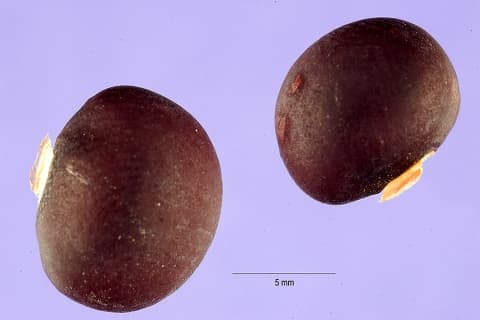
Pachyrhizus ahipa
Pachyrhizus ahipa
Safety & Hazards
The seed and green parts of the plant contain an insecticide (probably rotenone) and might be poisonous to people[1].
Cultivation Details
Pachyrhizus ahipa succeeds in tropical to subtropical climates, the plant can be found at elevations from sea level to 3,000 metre[2]s. At the higher elevations, plants can experience a diurnal temperature range that can fall to 0°c at night and rie to 35°c in the day[3]. It grows best in areas where the mean temperature ranges from a minimum of 12°c to a maximum of 22°c, though it can tolerate 10 - 30°c[2]. It prefers a mean annual rainfall of 800 - 1,200mm, though it will tolerate 750 - 1,250mm with a dry season of up to 8 months[418[3]]. Grows best in a sunny position[2]. Prefers a fertile, well-drained, sandy to loamy soil[2]. Prefers a pH in the range 5.5 - 6.5, though it can tolerate 5 - 8[2]. The plant is drought tolerant, but good tuber production requires moist growing conditions[3]. This species is generally considered to be daylength-neutral, making it suitable for growing in areas outside the tropics so long as the growing season is long enough[1, 3]. It has produced good yields when grown in a greenhouse in Denmark[1]. The plant begins flowering about 75 days after planting and harvest takes place after 150 - 180 days[1, 2]. Unless being grown for seed production, plants are normally prevented from flowering since this increases tuber size[3]. Annual yields at moderate elevations in the Bolivian Andes can be 8 - 30 tonnes per hectare[3]. This species has a symbiotic relationship with certain soil bacteria, these bacteria form nodules on the roots and fix atmospheric nitrogen. Some of this nitrogen is utilized by the growing plant but some can also be used by other plants growing nearby[4].
Propagation
Pre-soak the seed for 12 hours in warm water and then sow in early spring in a warm greenhouse. Germination should take place within 2 weeks. As soon as they are large enough to handle, prick out the seedlings into individual pots of rich soil and grow them on fast. Plant them out after the last expected frosts. Give the plants some protection, such as a cloche, until they are growing away well. Division of the root tubers in the autumn. Store the roots in a cool but frost-free place over the winter, planting them into pots in the greenhouse in early spring and planting them out after the last expected frosts. Give the plants some protection, such as a cloche, until they are growing away well. Cuttings. Cite as: Temperate Plants Database, Ken Fern. temperate.theferns.info. 2026-02-21. <temperate.theferns.info/plant/Pachyrhizus+ahipa>
Pollinators
Insects, Self
References
- [1]Lost Crops of the Incas — Popenoe. H. et al · National Academy Press · 1990 · ISBN 0-309-04264-X ↩︎An excellent book. Very readable, with lots of information and good pictures of some lesser known food plants of S. America.
- [2]Ecocrop — http://ecocrop.fao.org/ecocrop/srv/en/home ↩︎Basic information on a wide range of useful plants, plus details of environmental needs where available.
- [3]Ahipa (Pachyrhizus ahipa (Wedd.) Parodi) in Bolivia — Ørting B.; Grüneberg W.J. & Sörensen M. · 1996 ↩︎
- [4]The New RHS Dictionary of Gardening. 1992. — Huxley. A. · MacMillan Press · 1992 · ISBN 0-333-47494-5 ↩︎Excellent and very comprehensive, though it contains a number of silly mistakes. Readable yet also very detailed.
- [PFAF]Plants for a Future — pfaf.org ↩︎