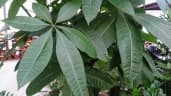
Pachira aquatica
Pachira aquatica
Safety & Hazards
None known
Cultivation Details
A plant of the humid tropics, it is able to tolerate a wide range of temperatures and humidity[1]. Prefers a deep, fertile loamy soil in full sun or light shade[2, 3]. Established plants are drought resistant[1]. The seeds are able to float in water for several months without loss of viability, not germinating until they are washed up on the land[3]. A fast-growing tree, able to reach a height of 3.5 metres within 2 years from seed[4]. Flowers are first produced when plants are 4 - 5 years[1]. Flowering and fruiting can take place throughout the year[1]. Plants are often grown as bonsai specimens and house plants, being very tolerant of drought and shade[5].
Propagation
Seed - - best sown as soon as it is ripe in a partially shaded position in individual containers. A germination rate of almost 100% can be expected, with the seed sprouting within 5 - 10 days[1, 4]. Seedlings grow away quickly and they should be ready to plant out 3 - 4 months later[1, 4]. The seed has a very short viability of 20 - 30 days in storage[4]. Cuttings Layering Cite as: Tropical Plants Database, Ken Fern. tropical.theferns.info. 2026-02-20. <tropical.theferns.info/viewtropical.php?id=Pachira+aquatica>
Pollinators
Bats
References
- [1]Edible Nuts. — Wickens G.E. · FAO, Rome. · 1995 · http://www.fao.org/docrep/ · ISBN 92-5-103748-5 ↩︎Detailed information on 20 of the most valuable nut crops, plus more basic information on a wide range of other nut-producing plants. It can be downloaded from the Internet.
- [2]The New RHS Dictionary of Gardening. 1992. — Huxley. A. · MacMillan Press · 1992 · ISBN 0-333-47494-5 ↩︎Excellent and very comprehensive, though it contains a number of silly mistakes. Readable yet also very detailed.
- [3]Tropical and Subtropical Trees - A Worldwide Encyclopaedic Guide. — Barwick. M. · Thames & Hudson, London · 2004 · ISBN 0-500-51181-0 ↩︎A superb book, very concise and well written, giving a wealth of information on 400 or more species including descriptions, habitat, cultivation details and plant uses. A wealth of colour photographs bring each plant vividly to life.
- [4]Brazilian Trees. Volume 1. 4th Edition. — Lorenzi. H. · Instituto Plantarum De Estudos Da Flora; Brazil. · 2002 · ISBN 85-86714-17-8 ↩︎Information on 350 species of Brazilian trees. Stunning photographs of each species, brief details on the plant, its uses and how to grow it from seed. A superb work, with the minor irritation that the translation from Portuguese is not of the best.
- [5]Flora of China — Missouri Botanical Garden Press; St. Louis. · 1994 · http://flora.huh.harvard.edu/china/ ↩︎An excellent, comprehensive resource in 25 volumes. In addition to the botanical information the flora also gives basic information on habitat and some uses. An on-line version is also available.
- [6]Cornucopia II — Facciola. S. · Kampong Publications, California. · 1998 · ISBN 0-9628087-2-5 ↩︎The second edition of an excellent guide to the edible uses of plants, though it does not give any details of cultivation etc.
- [7]Medicinal Plants of the Guianas — DeFilipps, R. A.; Maina, S. L.; & Crepin, J. · Smithsonian Museum · http://botany.si.edu/bdg/medicinal/index.html ↩︎A down-loadable PDF document of a book in pre-publication awaiting illustration. An excellent, if rather terse, guide to the traditional medicinal uses of the plants of the region