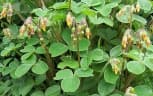
Oxalis tuberosa
Oxalis tuberosa
Safety & Hazards
The leaves contain oxalic acid, which gives them their sharp flavour. Perfectly all right in small quantities, the leaves should not be eaten in large amounts since oxalic acid can bind up the body's supply of calcium leading to nutritional deficiency. The quantity of oxalic acid will be reduced if the leaves are cooked. People with a tendency to rheumatism, arthritis, gout, kidney stones or hyperacidity should take especial caution if including this plant in their diet since it can aggravate their condition[1].
Cultivation Details
A plant of higher elevations in the tropics, where it is found at elevations from 2,800 - 4,200 metres. It can be grown down to sea level in the subtropics and can also be grown in some parts of the temperate zone - its main limitation is that it requires a daylength of less than 12 hours before it starts to develop tubers[2, PFAF]. It grows best in areas where annual daytime temperatures are within the range 12 - 24°c, but can tolerate 5 - 28°c[2]. Frost kills back its foliage, however the plant's tubers have exceptional regenerative capacity[2]. It prefers a mean annual rainfall in the range 800 - 1,300mm, but tolerates 570 - 2,150mm[3, 2]. Prefers a light rich soil in a warm sunny position[4, 5, 3]. Tolerant of most soils that are fertile and well-drained[2]. Prefers a pH in the range 6 - 7, tolerating 5.3 - 7.8[3, 2]. This species has an excellent potential as a major root crop in temperate zones, it has the potential to yield as highly as potatoes but does not have the susceptibility to pests and diseases that are a bugbane for potato growers[PFAF]. Plants are slightly more hardy than the potato, tolerating light frosts but the top-growth being severely damaged or killed by temperatures much below freezing. The main drawback is that development of the tubers is initiated by the number of hours of daylight in a day. In Britain this means that tubers do not begin to form until after the 21st of September and, if there are early frosts in the autumn, yields will be low[5]. There are possibly some forms in southern Chile that are not sensitive to daylength, these will be more suitable to higher latitudes such as Britain[3]. It is said that the varieties with white tubers are bitter because they contain calcium oxylate crystals whilst those with tubers that are of other colours are sweet[6]. However, we are growing one variety with white tubers and it most certainly is not bitter[PFAF]. Yields tend to average about 7 - 10 tonnes per hectare but experimentally yields of 40 tonnes per hectare have been achieved[3]. Earthing up the growing stems as they start to form tubers can increase yields significantly[3].
Propagation
Seed - best sown as soon as it is ripe in a cold frame. Prick out the seedlings into individual pots when they are large enough to handle and plant them out in late spring or early summer. Seed is not usually produced in Britain. Harvest the tubers in late autumn after the frosts have killed off top growth. Store in a cool dry frost free place and plant out in mid spring. Basal cuttings in spring[3]. Harvest the shoots with plenty of underground stem when they are about 8 - 10cm above the ground. Pot them up into individual pots and keep them in light shade in a cold frame or greenhouse until they are rooting well. Plant them out in the summer. Cite as: Temperate Plants Database, Ken Fern. temperate.theferns.info. 2026-02-21. <temperate.theferns.info/plant/Oxalis+tuberosa>
Pollinators
Insects
References
- [1]Encyclopaedia of Herbs and their Uses. — Bown. D. · Dorling Kindersley, London. · 1995 · ISBN 0-7513-020-31 ↩︎A very well presented and informative book on herbs from around the globe. Plenty in it for both the casual reader and the serious student. Just one main quibble is the silly way of having two separate entries for each plant.
- [2]Ecocrop — http://ecocrop.fao.org/ecocrop/srv/en/home ↩︎Basic information on a wide range of useful plants, plus details of environmental needs where available.
- [3]Lost Crops of the Incas — Popenoe. H. et al · National Academy Press · 1990 · ISBN 0-309-04264-X ↩︎An excellent book. Very readable, with lots of information and good pictures of some lesser known food plants of S. America.
- [4]RHS Dictionary of Plants plus Supplement. 1956 — F. Chittendon. · Oxford University Press · 1951 · ISBN - ↩︎Comprehensive listing of species and how to grow them. Somewhat outdated, it has been replaced in 1992 by a new dictionary (see [ 200 ]).
- [5]The Gardener's Assistant. — Thompson. B. · Blackie and Son. · 1878 · ISBN - ↩︎Excellent general but extensive guide to gardening practices in the 19th century. A very good section on fruits and vegetables with many little known species.
- [6]The Ethno-Botany of Pre-Columbian Peru. — Towle. M. A. · Aldine Publishing Co. Chicago. · 1961 ↩︎A very interesting book covering quite a lot of information on plant uses in S. America although many of the plants are not suitable for temperate areas.
- [7]Rare Vegetables for Garden and Table. — Organ. J. · Faber · 1960 · ISBN - ↩︎Unusual vegetables that can be grown outdoors in Britain. A good guide.
- [8]Cornucopia II — Facciola. S. · Kampong Publications, California. · 1998 · ISBN 0-9628087-2-5 ↩︎The second edition of an excellent guide to the edible uses of plants, though it does not give any details of cultivation etc.
- [9]Sturtevant's Edible Plants of the World. — Hedrick. U. P. · Dover Publications · 1972 · ISBN 0-486-20459-6 ↩︎Lots of entries, quite a lot of information in most entries and references.
- [10]Flowering Plants of the World. — Haywood. V. H. · Oxford University Press · ISBN 0-19-217674-9 ↩︎Very readable and well illustrated, it lists plants by families giving the basic diagnostic features and some details of plant uses.
- [11]Cornucopia - A Source Book of Edible Plants. — Facciola. S. · Kampong Publications · 1990 · ISBN 0-9628087-0-9 ↩︎Excellent. Contains a very wide range of conventional and unconventional food plants (including tropical) and where they can be obtained (mainly N. American nurseries but also research institutes and a lot of other nurseries from around the world.
- [12]The Oxford Book of Food Plants. — Harrison. S. Wallis. M. Masefield. G. · Oxford University Press · 1975 · ISBN - ↩︎Good drawings of some of the more common food plants from around the world. Not much information though.
- [PFAF]Plants for a Future — pfaf.org ↩︎