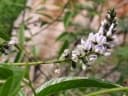
Otholobium glandulosum
Otholobium glandulosum
Safety & Hazards
Although no specific mention of toxicity for this species has been found, at least some members of this genus are known to contain furanocoumarins, particularly psoralen and angelicin. These compounds can be found in low concentrations in many common foods including citrus fruirs, celery, parsley and parsnips. Ingestion or skin application of these compounds in larger quantities can cause skin photosensitization followed by hyperpigmentation[1, 2].
Cultivation Details
Otholobium glandulosum is mainly found in the subtropics of Chile, though plants can also grow at higher elevations in the tropics and outdoors in warmer parts of the temperate zone. Fully dormant plants can tolerate short-lived temperatures down to around -5 to -10°c provided they are grown in a perfectly drained soil with preferably with some protection such as a sunny wall[3]. Plants can regrow from buds low down on old wood if the are cut back by frosts[3]. Depending on provenence, there are tender and hardier forms of this species[4]. Succeeds in an ordinary garden soil[5]. Requires a sunny position[6] and a well-drained soil[3]. Flowers are produced on the previous seasons growth and also late in the season on the current seasons[3]. The leaves are aromatic[7]. This species has a symbiotic relationship with certain soil bacteria, these bacteria form nodules on the roots and fix atmospheric nitrogen. Some of this nitrogen is utilized by the growing plant but some can also be used by other plants growing nearby[3].
Propagation
Pre-soak the seed for 24 hours in warm water and sow in early to mid spring in a greenhouse[3]. as soon as they are large enough to handle, prick the seedlings out into individual pots and grow them on in light shade in the cold frame for at least their first winter. Plant them out into their permanent positions in late spring or early summer, after the last expected frosts. Cuttings of half-ripe wood, mid summer in a frame[8]. Cite as: Temperate Plants Database, Ken Fern. temperate.theferns.info. 2026-02-21. <temperate.theferns.info/plant/Otholobium+glandulosum>
Pollinators
Insects
References
- [1]A Colour Atlas of Poisonous Plants. — Frohne. D. and Pfänder. J. · Wolfe · 1984 · ISBN 0723408394 ↩︎Brilliant. Goes into technical details but in a very readable way. The best work on the subject that I've come across so far.
- [2]Furocoumarins and Other Secondary Metabolites from Psoralea canescens — Innocenti G.; Bourgaud F.; Piovan A. & Favretto D. · 1997 · ISBN 0925-1618 ↩︎
- [3]The New RHS Dictionary of Gardening. 1992. — Huxley. A. · MacMillan Press · 1992 · ISBN 0-333-47494-5 ↩︎Excellent and very comprehensive, though it contains a number of silly mistakes. Readable yet also very detailed.
- [4]The Milder Garden. — Taylor. J. · Dent · 1990 ↩︎A good book on plants that you didn't know could be grown outdoors in Britain.
- [5]RHS Dictionary of Plants plus Supplement. 1956 — F. Chittendon. · Oxford University Press · 1951 · ISBN - ↩︎Comprehensive listing of species and how to grow them. Somewhat outdated, it has been replaced in 1992 by a new dictionary (see [ 200 ]).
- [6]Ornamental Shrubs, Climbers and Bamboos. — Thomas. G. S. · Murray · 1992 · ISBN 0-7195-5043-2 ↩︎Contains a wide range of plants with a brief description, mainly of their ornamental value but also usually of cultivation details and varieties.
- [7]Raintree Nutrition - Tropical Plant Database — http://www.rain-tree.com/plants.htm ↩︎Detailed information on the medicinal uses of more than two hundred rainforest plants, mainly from S. America, with basic descriptions of the plants, their other uses etc.
- [8]Trees and Shrubs Hardy in Great Britain. Vol 1 - 4 and Supplement. — Bean. W. · Murray · 1981 · ISBN - ↩︎A classic with a wealth of information on the plants, but poor on pictures.
- [9]Flora of Chile. (in Spanish) — ? ↩︎Some information about the useful plants of Chile.
- [10]Sturtevant's Edible Plants of the World. — Hedrick. U. P. · Dover Publications · 1972 · ISBN 0-486-20459-6 ↩︎Lots of entries, quite a lot of information in most entries and references.
- [11]Dictionary of Economic Plants. — Uphof. J. C. Th. · Weinheim · 1959 · ISBN - ↩︎An excellent and very comprehensive guide but it only gives very short descriptions of the uses without any details of how to utilize the plants. Not for the casual reader.
- [12]A Dictionary of Plants Used by Man. — Usher. G. · Constable · 1974 · ISBN 0094579202 ↩︎Forget the sexist title, this is one of the best books on the subject. Lists a very extensive range of useful plants from around the world with very brief details of the uses. Not for the casual reader.
- [13]Cornucopia - A Source Book of Edible Plants. — Facciola. S. · Kampong Publications · 1990 · ISBN 0-9628087-0-9 ↩︎Excellent. Contains a very wide range of conventional and unconventional food plants (including tropical) and where they can be obtained (mainly N. American nurseries but also research institutes and a lot of other nurseries from around the world.
- [14]A Modern Herbal. — Grieve. · Penguin · 1984 · ISBN 0-14-046-440-9 ↩︎Not so modern (1930's?) but lots of information, mainly temperate plants.