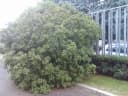
Osmanthus fragrans
Osmanthus fragrans
Safety & Hazards
None known
Cultivation Details
Osmanthus fragrans is a plant mainly of the subtropics, cultivated in many tropical and werm temperate areas for its highly fragrant flowers. Given hot summers, it has moderate resistance to frost, with selected forms able to withstand occasional temperatures down to around -10°c[1]. Easily grown in any moist but well-drained soil in sun or part shade[2, 3, 4], but flowering more freely in a sunny position[2]. Thrives in chalky conditions[2]. Plants can succeed in heavy clays and are drought resistant once established[4]. Dislikes unduly exposed positions[2], and requires shelter from freezing winds[3]. The flowers are very fragrant[5]. A powerful fragrance of apricots[4].
Propagation
Seed - best sown as soon as it is ripe in a coldframe[3]. Stored seed probably germinates best if it is given 3 months warm then 3 months cold stratification before sowing[6]. The seed usually takes 6 - 18 months to germinate, it should be pricked out into individual pots when it is large enough to handle. Grow the plants on for their first winter in the greenhouse and plant them out in early summer. Cuttings of half-ripe wood taken at the end of July, in a frame with bottom heat[2]. Cuttings of almost ripe wood, 7 - 12cm with a heel, September/early autumn in a cold frame. A good percentage. Plant out in the spring 18 months later[7]. Layering in spring[3] or autumn[7]. Partially sever the layer leads in the following late summer and plant out in the autumn. High percentage[7]. Cite as: Temperate Plants Database, Ken Fern. temperate.theferns.info. 2026-02-21. <temperate.theferns.info/plant/Osmanthus+fragrans>
Pollinators
Data unavailable
References
- [1]New Trees — Grimshaw J.; Bayton R.; Wilks H. · Kew Publishing; London · 2009 · ISBN 1842461737 ↩︎Provides comprehensive botanical descriptions and horticultural commentary on over 800 tree species that have been introduced to cultivation in recent decades.
- [2]Trees and Shrubs Hardy in Great Britain. Vol 1 - 4 and Supplement. — Bean. W. · Murray · 1981 · ISBN - ↩︎A classic with a wealth of information on the plants, but poor on pictures.
- [3]The New RHS Dictionary of Gardening. 1992. — Huxley. A. · MacMillan Press · 1992 · ISBN 0-333-47494-5 ↩︎Excellent and very comprehensive, though it contains a number of silly mistakes. Readable yet also very detailed.
- [4]KemperCentreForHomeGardeningPlantFinder — Missouri Botanical Garden · http://www.mobot.org/gardeninghelp/plantfinder/ ↩︎Basic cultivation details, plant uses, habitat etc for several thousand species of plants, mainly from the temperate zone.
- [5]Gardening on Walls — Grey-Wilson. C. & Matthews. V. · Collins · 1983 · ISBN 0-00-219220-0 ↩︎A nice little book about plants for growing against walls and a small section on plants that can grow in walls.
- [6]The Reference Manual of Woody Plant Propagation. — Dirr. M. A. and Heuser. M. W. · Athens Ga. Varsity Press · 1987 · ISBN 0942375009 ↩︎A very detailed book on propagating trees. Not for the casual reader.
- [7]Propagation of Trees, Shrubs and Conifers. — Sheat. W. G. · MacMillan and Co · 1948 · ISBN - ↩︎A bit dated but a good book on propagation techniques with specific details for a wide range of plants.
- [8]Flora of China — Missouri Botanical Garden Press; St. Louis. · 1994 · http://flora.huh.harvard.edu/china/ ↩︎An excellent, comprehensive resource in 25 volumes. In addition to the botanical information the flora also gives basic information on habitat and some uses. An on-line version is also available.
- [9]Cornucopia - A Source Book of Edible Plants. — Facciola. S. · Kampong Publications · 1990 · ISBN 0-9628087-0-9 ↩︎Excellent. Contains a very wide range of conventional and unconventional food plants (including tropical) and where they can be obtained (mainly N. American nurseries but also research institutes and a lot of other nurseries from around the world.
- [10]Mansfeld's Database of Agricultural and Horticultural Plants — http://mansfeld.ipk-gatersleben.de/pls/htmldb_pgrc/f?p=185:3:4292127278597336 ↩︎Terse details of a huge range of useful plants.
- [11]Flora of Japan. (English translation) — Ohwi. G. · Smithsonian Institution · 1965 · ISBN - ↩︎The standard work. Brilliant, but not for the casual reader.
- [12]A Manual of Indian Timbers. — Gamble. J. S. · Bishen Singh Mahendra Pal Singh · 1972 · ISBN - ↩︎First written in the 19th century, but still a classic, giving a lot of information on the uses and habitats of Indian trees. Not for the casual reader.
- [13]Plants and People of Nepal — Manandhar. N. P. · Timber Press. Oregon. · 2002 · ISBN 0-88192-527-6 ↩︎Excellent book, covering over 1,500 species of useful plants from Nepal together with information on the geography and peoples of Nepal. Good descriptions of the plants with terse notes on their uses.
- [14]Sturtevant's Edible Plants of the World. — Hedrick. U. P. · Dover Publications · 1972 · ISBN 0-486-20459-6 ↩︎Lots of entries, quite a lot of information in most entries and references.
- [15]Dictionary of Economic Plants. — Uphof. J. C. Th. · Weinheim · 1959 · ISBN - ↩︎An excellent and very comprehensive guide but it only gives very short descriptions of the uses without any details of how to utilize the plants. Not for the casual reader.
- [16]A Dictionary of Plants Used by Man. — Usher. G. · Constable · 1974 · ISBN 0094579202 ↩︎Forget the sexist title, this is one of the best books on the subject. Lists a very extensive range of useful plants from around the world with very brief details of the uses. Not for the casual reader.
- [17]Chinese Materia Medica. — Stuart. Rev. G. A. · Taipei. Southern Materials Centre · 1911 · ISBN - ↩︎A translation of an ancient Chinese herbal. Fascinating.
- [18]Ethnobotany of the Himalayas — Kunwar R.M., Sher H. & Bussmann R.W. (Eds) · Springer Nature; Switzerland · 2021 · https://doi.org/10.1007/978-3-030-57408-6 · ISBN 978-3-030-57407-9 ↩︎
- [19]Medicinal Plants of China — Duke. J. A. and Ayensu. E. S. · Reference Publications, Inc. · 1985 · ISBN 0-917256-20-4 ↩︎Details of over 1,200 medicinal plants of China and brief details of their uses. Often includes an analysis, or at least a list of constituents. Heavy going if you are not into the subject.
- [20]Common Chinese Materia Medica Volume 6 — Huagu Ye et al (Editors) · Springer Nature Singapore Pte Ltd., Singapore · 2022 · https://doi.org/10.1007/978-981-16-5892-1 · ISBN 978-981-16-5891- ↩︎
- [21]Indian Medicinal Plants; An Illustrated Dictionary — Khare C.P. (Ed.) · Springer-Verlag Berlin/Heidelberg · 2007 · ISBN 978-0-387-70637-5 ↩︎
- [PFAF]Plants for a Future — pfaf.org ↩︎