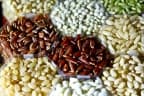
Oryza sativa
Oryza sativa
Safety & Hazards
None known
Cultivation Details
Rice can be grown in the moist tropics, subtropics and warm temperate zone, succeeding at elevations up to 2,500 metres in tropical areas. It grows best in areas where annual daytime temperatures are within the range 20 - 30°c, but can tolerate 10 - 36°c[1]. Growth ceases below 10°c and plants have no tolerance to frost[1]. It prefers a mean annual rainfall in the range 1,500 - 2,000mm, but tolerates 1,000 - 4,000mm[1]. Requires a wet to inundated soil and a position in full sun[2]. Prefers a pH in the range 5.5 - 7, tolerating 4.5 - 9[1]. Depending upon variety, rice can mature a crop of seed in anything from 60 - 200 days[1]. There are many named varieties that have been developed from the original wild form and can be grown in a wide diversity of climates and soil types[3]. These can be grouped into three main forms:- Japonica - developed in the cooler regions of the tropics and subtropics, it can also be grown in warm temperate areas. Small to medium plants, they develop few tillers and produce short, roundish grains that tend to be moist and sticky when cooked[4]. Javanica (often called tropical Japonica) - grown at higher elevations in the tropics, they are tall plants that develop few tillers. They produce long, broad, thick grains[4]. Indica - the major form of rice, cultivated widely at lower to medium elevations in the tropics and subtropics. Tall plants, they form many tillers and produce slender, short to long grains that are drier and flakier when cooked[4]. There are many different cultivars of each form. Some of these cultivars are starchy and are more suited to use in cakes, soups, pastry, breakfast foods etc[5]. Other cultivars have a sweeter, glutinous texture, these are used for special purposes such as sweetmeats[5]. Within these divisions, the varieties are further defined by whether they have short, medium or long grains[5]. Long grained forms usually have the highest value, though short-grained forms are preferred in many countries[5].
Propagation
Seed - Cite as: Tropical Plants Database, Ken Fern. tropical.theferns.info. 2026-02-20. <tropical.theferns.info/viewtropical.php?id=Oryza+sativa>
Pollinators
Wind
References
- [1]Ecocrop — http://ecocrop.fao.org/ecocrop/srv/en/home ↩︎Basic information on a wide range of useful plants, plus details of environmental needs where available.
- [2]Encyclopaedia of Herbs and their Uses. — Bown. D. · Dorling Kindersley, London. · 1995 · ISBN 0-7513-020-31 ↩︎A very well presented and informative book on herbs from around the globe. Plenty in it for both the casual reader and the serious student. Just one main quibble is the silly way of having two separate entries for each plant.
- [3]The New RHS Dictionary of Gardening. 1992. — Huxley. A. · MacMillan Press · 1992 · ISBN 0-333-47494-5 ↩︎Excellent and very comprehensive, though it contains a number of silly mistakes. Readable yet also very detailed.
- [4]The Wild Relatives of Rice, A Genetic Resources Handbook — Vaughan D.A. · International Rice Research Institute; Philippines · 1994 · http://irri.org/ · ISBN 971-22-0057-4 ↩︎An excellent guide to the wild species of the genus Oryza. It gives good descriptions of the species, habitats etc and often gives details of uses. It can be downloaded from the Internet
- [5]Dictionary of Economic Plants. — Uphof. J. C. Th. · Weinheim · 1959 · ISBN - ↩︎An excellent and very comprehensive guide but it only gives very short descriptions of the uses without any details of how to utilize the plants. Not for the casual reader.
- [6]Plants and People of Nepal — Manandhar. N. P. · Timber Press. Oregon. · 2002 · ISBN 0-88192-527-6 ↩︎Excellent book, covering over 1,500 species of useful plants from Nepal together with information on the geography and peoples of Nepal. Good descriptions of the plants with terse notes on their uses.