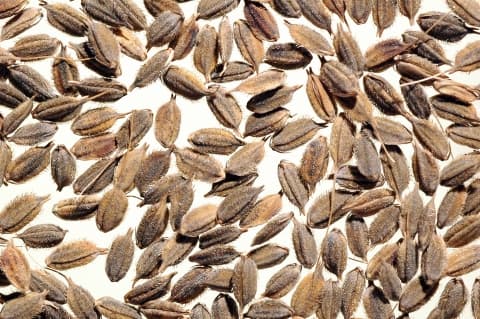
Oryza officinalis
Oryza officinalis
Safety & Hazards
None known
Cultivation Details
Succeeds in full sun and in partial shade. Prefers alluvial silt soils or sandy soils on limestone in the wild[1]. Growth is slow at the seedling stage. Oryza species form a group of C3- cycle plants. Flowering occurs near the end of the prevailing rainy season. Grains are usually deciduous and often have a strong dormancy[2]. Plants can be in flower at any time of the year[1].
Propagation
Seed. The seed of wild rice less than 12 months old often exhibits strong dormancy, which implies (though this has not been established) that the seed retains its viability for a considerable period[1]. Heat treatment is generally effective in breaking dormancy - alternating temperatures between 34°c for 16 hours then 11°c for 8 hours is usually effective, though the time taken varies between species[1]. Surface sow the seed in light shade and do not allow to dry out. Seed should germinate within 7 days at 30°c[1]. Prick out 2 - 3 seedlings into individual pots when large enough to handle and, after a few days, move to a sunny position. Grow on until large enough to plant out. Cite as: Tropical Plants Database, Ken Fern. tropical.theferns.info. 2026-02-20. <tropical.theferns.info/viewtropical.php?id=Oryza+officinalis>
Pollinators
Wind
References
- [1]The Wild Relatives of Rice, A Genetic Resources Handbook — Vaughan D.A. · International Rice Research Institute; Philippines · 1994 · http://irri.org/ · ISBN 971-22-0057-4 ↩︎An excellent guide to the wild species of the genus Oryza. It gives good descriptions of the species, habitats etc and often gives details of uses. It can be downloaded from the Internet
- [2]Plant Resources of Southeast Asia — http://proseanet.org/ ↩︎Lots of information on the uses of the plants of SE Asia.
- [3]IUCN Red List of Threatened Species — http://www.iucnredlist.org/ ↩︎A list of plants under threat and facing possible extinction, usually with brief details of the threats and information on habitat.