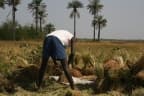
Oryza glaberrima
Oryza glaberrima
Safety & Hazards
None known
Cultivation Details
A plant of the moist tropics, where it is found at elevations from near sea level to over 1,700 metres[1]. It grows best in areas where annual daytime temperatures are within the range 26 - 32°c, but can tolerate 16 - 38°c[2]. It prefers a mean annual rainfall in the range 1,000 - 1,500mm, but tolerates 700 - 2,700mm[2]. Requires a sunny position. Prefers a pH in the range 5.5 - 7, tolerating 4.3 - 9[2]. African rice is considered hardier than the more commonly cultivated rice, O. Sativa[2]. Yields of 0.7 - 1.0 t/ha can be obtained[2]. The species shows immense diversity, and some 1,500 varietal cultivars are known[3]. The species was probably derived from Oryza barthii, which grew wild and was extensively harvested in the Sahara region when it was much moister, up to about 1,500 BC. With the climate becoming drier, many people moved south, taking their seeds with them and this species became extensively cultivated, flourishing until the Sixteenth century when Asian rice cultivars reached W Africa[1, 3]. It is now grown on less than 20% of the land devoted to rice culture[1]. A curious parallel with Asian rice (Oryza sativa) is to be found in the diversity of this plant, with cultivars adapted to hill (dry), swamp, flood and floating conditions. Some will grow in water to 250cm deep and withstand immersion for 3 - 4 days, and produce culms 4 - 5 metres long[3]. As with the other rices indigenous to Africa, the grain tends to shatter, thus requiring reaping of the entire panicle before final maturity. Asian rice strains do not suffer this defect[3].
Propagation
Seed - germinates within 4 - 5 days from sowing[1]. Seed. The seed of wild rice less than 12 months old often exhibits strong dormancy, which implies (though this has not been established) that the seed retains its viability for a considerable period[4]. Heat treatment is generally effective in breaking dormancy - alternating temperatures between 34°c for 16 hours then 11°c for 8 hours is usually effective, though the time taken varies between species[4]. Surface sow the seed in light shade and do not allow to dry out. Seed should germinate within 7 days at 30°c[4]. Prick out 2 - 3 seedlings into individual pots when large enough to handle and, after a few days, move to a sunny position. Grow on until large enough to plant out. Cite as: Tropical Plants Database, Ken Fern. tropical.theferns.info. 2026-02-20. <tropical.theferns.info/viewtropical.php?id=Oryza+glaberrima>
Pollinators
Wind
References
- [1]Protabase - Plant Resources of Tropical Africa. — http://www.prota.org ↩︎An excellent on-line database with detailed information on over 3,200 species of useful plants of Africa.
- [2]Ecocrop — http://ecocrop.fao.org/ecocrop/srv/en/home ↩︎Basic information on a wide range of useful plants, plus details of environmental needs where available.
- [3]The Useful Plants of West Tropical Africa. — Burkil. H. M. · Royal Botanic Gardens; Kew. · 1985 - 2004 ↩︎Brief descriptions and details of the uses of over 4,000 plants. A superb, if terse, resource, it is also available electronically on the Web - see http://www.aluka.org/
- [4]The Wild Relatives of Rice, A Genetic Resources Handbook — Vaughan D.A. · International Rice Research Institute; Philippines · 1994 · http://irri.org/ · ISBN 971-22-0057-4 ↩︎An excellent guide to the wild species of the genus Oryza. It gives good descriptions of the species, habitats etc and often gives details of uses. It can be downloaded from the Internet
- [5]Cornucopia II — Facciola. S. · Kampong Publications, California. · 1998 · ISBN 0-9628087-2-5 ↩︎The second edition of an excellent guide to the edible uses of plants, though it does not give any details of cultivation etc.