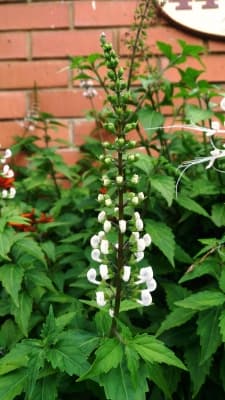
Orthosiphon aristatus
Orthosiphon aristatus
Safety & Hazards
None known
Cultivation Details
The plant has escaped from cultivation and become naturalised in some areas[1]. Harvest usually starts 8 - 10 weeks after planting, at the beginning of flowering. Every 2 - 3 weeks the upper 4 - 10 leaves of shoots are plucked by hand[2]. Annual yields of dry leaves amount to 1,500 kg/ha[2]. Smallholders usually sun-dry leaves. In estate farming artificial drying is practised. To obtain a high-quality product, the leaves are first withered in the air, and then dried at 45 - 50°c. Dried leaves of good quality are green (a blackish colour is due to overheating or contact with metal containers), have a good aroma, a moisture content below 14%, a bitter taste, an ash content of about 10%, a contamination content of less than 2%, and do not contain insects or fungi[2]. Three cultivars of Orthosiphon aristatus are distinguished: one with bluish-violet and two with white flowers. The white-flowered cultivar with reddish stems, petioles and leaf veins appears to possess the best diuretic qualities[2].
Propagation
Seed - Stem cuttings, 15 - 20cm long, which have some buds[2]. Cuttings are usually planted in shade, with 40 - 60cm between plants and rows. Often 4 - 6 cuttings are placed in one hole. Direct planting in the field or in the backyard, as is most common, can be done all the year round, but the usual time of planting is at the beginning of the rainy season. For plantations, planting in a nursery for a period of 45 days with the cuttings placed vertically with only one bud visible is preferred[2]. Cite as: Tropical Plants Database, Ken Fern. tropical.theferns.info. 2026-02-20. <tropical.theferns.info/viewtropical.php?id=Orthosiphon+aristatus>
Pollinators
Data unavailable
References
- [1]Pacific Island Ecosystems at Risk — http://www.hear.org/pier/scientificnames/index.html ↩︎A very good website detailing weed species that have been introduced into the Pacific Islands.
- [2]Plant Resources of Southeast Asia — http://proseanet.org/ ↩︎Lots of information on the uses of the plants of SE Asia.
- [3]The Encyclopedia of Medicinal Plants — Chevallier. A. · Dorling Kindersley. London · 1996 · ISBN 9-780751-303148 ↩︎An excellent guide to over 500 of the more well known medicinal herbs from around the world.
- [4]Flora of Peninsula Malaysia — http://www.tfbc.frim.gov.my ↩︎In the process of being assembled (15/07/09), it is currently a series of check sheets giving species name, brief description, habitat and high quality photos of the plants.
- [5]Medicinal Plants of the Guianas — DeFilipps, R. A.; Maina, S. L.; & Crepin, J. · Smithsonian Museum · http://botany.si.edu/bdg/medicinal/index.html ↩︎A down-loadable PDF document of a book in pre-publication awaiting illustration. An excellent, if rather terse, guide to the traditional medicinal uses of the plants of the region