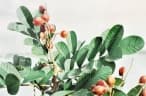
Ormosia coccinea
Ormosia coccinea
Cultivation Details
Usually found in well-drained soils in the wild[2]. The seedpods open whilst still on the tree. The seeds, however, often remain in the canopy for months after this, resting in the open pods until the wind or some animal dislodges them - or until the pod rots and falls to earth. Once in the moist soil, the seed germinates immediately[2]. This species has a symbiotic relationship with certain soil bacteria; these bacteria form nodules on the roots and fix atmospheric nitrogen. Some of this nitrogen is utilized by the growing plant but some can also be used by other plants growing nearby[3].
Propagation
Like many species within the family Fabaceae, once they have been dried for storage the seeds of this species may benefit from scarification before sowing in order to speed up and improve germination. This can usually be done by pouring a small amount of nearly boiling water on the seeds (being careful not to cook them!) and then soaking them for 12 - 24 hours in warm water. By this time they should have imbibed moisture and swollen - if they have not, then carefully make a nick in the seedcoat (being careful not to damage the embryo) and soak for a further 12 hours before sowing[PFAF]. Cite as: Tropical Plants Database, Ken Fern. tropical.theferns.info. 2026-02-20. <tropical.theferns.info/viewtropical.php?id=Ormosia+coccinea>
Pollinators
Insects
References
- [1]Botanical Museum Leaflets Vol 21 — Botanical Museum; Cambridge, Massachusetts · 1963 - 1967 · http://www.biodiversitylibrary.org ↩︎A series of botanical articles. It can be downloaded from the Internet.
- [2]Trees of Costa Rica's Pacific Slope — http://www.cds.ed.cr/teachers/harmon/page1.html ↩︎Information on over 80 species of tree from the Pacific coast of Costa Rica.
- [3]Nodulation Plants in GRIN Taxonomy — United States Department of Agriculture · http://www.ars-grin.gov/~sbmljw/cgi-bin/taxnodul.pl?language=en ↩︎An online database listing plants that have either positive or negative reports on root and stem nodulation with nitrogen-fixing bacteria.
- [4]Flora of Barro Colorado Island — Croat. Thomas B. · Stanford University Press · 1978 · http://biogeodb.stri.si.edu/bioinformatics/croat/home · ISBN 0-8047-0950-5 ↩︎A very good flora of an area in Panama. Written some years ago, so some of the names have been changed. The book is out of print, but the whole flora is now available on the web.
- [5]Tree Species of Panama — http://ctfs.arnarb.harvard.edu/webatlas/mainframe.php?order=s ↩︎Factsheets on all the tree and shrub species of Panama, giving identification guide, brief guide to the species and some uses. A vast, but rather incomplete work as of 15/07/09.
- [6]Contributions from the United States National Herbarium. Vol. 32 — Rudd V.E. · Smithsonian Institution Press; Washington. · 1968 · http://www.biodiversitylibrary.org ↩︎Monographs of several species in the family Fabaceae, including the Ormosia that occur in the Americas. It can be downloaded from the Internet.
- [7]Tropix 7 — CIRAD · http://tropix.cirad.fr/en ↩︎An on-line guide to the timbers of 245 species of trees.
- [PFAF]Plants for a Future — pfaf.org ↩︎