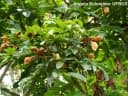
Ormosia arborea
Ormosia arborea
Safety & Hazards
The plants, but especially the seed and perhaps also the bark, of many if not all species in this genus contain alkaloids and are toxic[1].
Cultivation Details
Thrives in drier, well-drained soils[2]. The tree is moderately fast growing, able to reach a height of around 2.5 metres within 2 years from seed[2]. This species has a symbiotic relationship with certain soil bacteria, these bacteria form nodules on the roots and fix atmospheric nitrogen. Some of this nitrogen is utilized by the growing plant but some can also be used by other plants growing nearby[].
Propagation
Seed - it has a hard seedcoat and may benefit from scarification before sowing to speed up germination. This can usually be done by pouring a small amount of nearly boiling water on the seeds (being careful not to cook them!) and then soaking them for 12 - 24 hours in warm water. By this time they should have imbibed moisture and swollen - if they have not, then carefully make a nick in the seedcoat (being careful not to damage the embryo) and soak for a further 12 hours before sowing. Sow the seed in a partially shaded position in a nursery seedbed or in individual containers. A germination rate in excess of 50% can be expected, with the seed sprouting within 20 - 50 days[2]. When the seedbed-sown seedlings are 5 - 7cm tall, pot them up into individual containers and they should be ready to plant out 8 - 10 months later[2]. The seed has a viability in excess of 12 months in storage[2]. Cite as: Tropical Plants Database, Ken Fern. tropical.theferns.info. 2026-02-20. <tropical.theferns.info/viewtropical.php?id=Ormosia+arborea>
Pollinators
Data unavailable
References
- [1]Botanical Museum Leaflets Vol 21 — Botanical Museum; Cambridge, Massachusetts · 1963 - 1967 · http://www.biodiversitylibrary.org ↩︎A series of botanical articles. It can be downloaded from the Internet.
- [2]Brazilian Trees. Volume 1. 4th Edition. — Lorenzi. H. · Instituto Plantarum De Estudos Da Flora; Brazil. · 2002 · ISBN 85-86714-17-8 ↩︎Information on 350 species of Brazilian trees. Stunning photographs of each species, brief details on the plant, its uses and how to grow it from seed. A superb work, with the minor irritation that the translation from Portuguese is not of the best.
- [3]Contributions from the United States National Herbarium. Vol. 32 — Rudd V.E. · Smithsonian Institution Press; Washington. · 1968 · http://www.biodiversitylibrary.org ↩︎Monographs of several species in the family Fabaceae, including the Ormosia that occur in the Americas. It can be downloaded from the Internet.
- [4]Tropical Timbers of the World. Ag. Handbook No. 607. — Chudnoff. Martin. · USDA Forest Service. Wisconsin. · 1984 ↩︎Terse details on the properties of the wood of almost 400 species of trees from the Tropics.