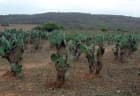
Opuntia cochenillifera
Opuntia cochenillifera
Safety & Hazards
The plant has numerous minutely barbed glochids - these are barbed spines that are usually small to minute and are very sharp and brittle. The glochids are very easily dislodged when the plant is touched and can penetrate the skin where, because of their barbs, they become stuck and are very difficult to see and remove. They can cause considerable irritation and discomfort[1, 2]. Opuntia species can contain quite high levels of oxalic acid, especially in older parts of the plant. Perfectly alright in small quantities, foods containing oxalic acid should not be eaten in large amounts since it can lock-up other nutrients in the food, especially calcium, thus causing mineral deficiencies. The oxalic acid content will be reduced if the plant is cooked. People with a tendency to rheumatism, arthritis, gout, kidney stones or hyperacidity should take especial caution if including this plant in their diet since it can aggravate their condition[3, 2].
Cultivation Details
Opuntia cochenillifera is a plant of arid and semi-arid areas in the tropics and subtropics, where it is found at elevations up to 1,500 metres, sometimes higher[4]. Requires a sunny position[5]. Thriving on neglect, the plant can tolerate almost any conditions so long as the soil is well-drained. Established plants are very drought tolerant[6].
Propagation
Seed - Prickly pear is easily propagated and the tiniest bit of leaf will take root almost anywhere[7]. Cite as: Tropical Plants Database, Ken Fern. tropical.theferns.info. 2026-02-20. <tropical.theferns.info/viewtropical.php?id=Opuntia+cochenillifera>
Pollinators
Bees
References
- [1]The New RHS Dictionary of Gardening. 1992. — Huxley. A. · MacMillan Press · 1992 · ISBN 0-333-47494-5 ↩︎Excellent and very comprehensive, though it contains a number of silly mistakes. Readable yet also very detailed.
- [2]A natural history of the Sonoran Desert — Phillips S.J. & Comus P.W. · University of California Press; Los Angeles, California · 2000 · ISBN 0-520-22029-3 ↩︎
- [3]Encyclopaedia of Herbs and their Uses. — Bown. D. · Dorling Kindersley, London. · 1995 · ISBN 0-7513-020-31 ↩︎A very well presented and informative book on herbs from around the globe. Plenty in it for both the casual reader and the serious student. Just one main quibble is the silly way of having two separate entries for each plant.
- [4]Flora of Guatemala — Standley P.C. & J. A. Steyermark · 1946 - 1976 · http://www.archive.org/ ↩︎A superb reference, though somewhat dated. Gives lots of plant uses as well as information on plant habit and habitat. The entire flora (13 volumes) can now be downloaded from http://www.archive.org/
- [5]Desert Tropicals — http://www.desert-tropicals.com/ ↩︎The main focus of the site is succulent plants, but it also contains information on a wide range of other species. Usually at least one good photograph, plus basic information about the plant and its cultivation.
- [6]Dictionary of Economic Plants. — Uphof. J. C. Th. · Weinheim · 1959 · ISBN - ↩︎An excellent and very comprehensive guide but it only gives very short descriptions of the uses without any details of how to utilize the plants. Not for the casual reader.
- [7]Global Invasive Species Database — http://www.issg.org/database/welcome/ ↩︎Very detailed information on almost 400 species (with more being added) of plants that have become weeds in areas outside their native range.
- [8]Mansfeld's Database of Agricultural and Horticultural Plants — http://mansfeld.ipk-gatersleben.de/pls/htmldb_pgrc/f?p=185:3:4292127278597336 ↩︎Terse details of a huge range of useful plants.
- [9]IUCN Red List of Threatened Species — http://www.iucnredlist.org/ ↩︎A list of plants under threat and facing possible extinction, usually with brief details of the threats and information on habitat.
- [10]Flora of N. America — http://flora.huh.harvard.edu/fna/ ↩︎An on-line version of the flora with an excellent description of the plant including a brief mention of plant uses.
- [11]Trees and Shrubs of Mexico — Standley P.C. · Smithsonian Institution; Washington · 1926 ↩︎Although dated, it contains a wealth of information on the trees and shrubs of Mexico, including many of their uses. It can be downloaded from the Internet.
- [12]Las Cactáceae de Guatemala — Véliz M.E. · Universidad de San Carlos de Guatemala, Guatemala · 2008 · ISBN 99922-2-551-3 ↩︎
- [13]Plantae Diaphoricae Florae Argentinae ó Revista Sistematica de las Plantas medicinales, alimenticias ó de alguna otr — Hieronymus J. · Guillermo Kraft; Buenos Aires · 1882 ↩︎A very old work, but lots of information on the uses of Argentinian plants. It can be downloaded from the internet.
- [14]Uses of Opuntia Species and the potential impact of Cactoblastis cactorum (Lepidoptera; Pyralidae) in Mexco — Vigueras A.L. & Portillo L. · 2001 ↩︎
- [15]Rio Mayo Plants - A study of the flora and vegetation of the valley of the Rio Mayo, Sonora — Gentry H.S. · Carnegie Institution of Washington; Washington DC · 1942 ↩︎One of my favourite authors on native plants, often including their uses. This is an excellent example with lots of information, even though the book is 80 years old.
- [16]Medicinal Plants of the Guianas — DeFilipps, R. A.; Maina, S. L.; & Crepin, J. · Smithsonian Museum · http://botany.si.edu/bdg/medicinal/index.html ↩︎A down-loadable PDF document of a book in pre-publication awaiting illustration. An excellent, if rather terse, guide to the traditional medicinal uses of the plants of the region
- [17]CosIng — http://ec.europa.eu/growth/tools-databases/cosing/ ↩︎CosIng is the European Commission database for information on cosmetic substances and ingredients.
- [18]The Cactus Family — Anderson E.F. · Timber Press; Portland, Oregon · 2001 · ISBN 0-88192-498-9 ↩︎An excellent work, giving botanical descriptions of virtually all the cacti, together with their range (but not their habitats) and sometimes also a photo. it also contains a long chapter detailing the many uses of cacti and another on cultivation..
- [PFAF]Plants for a Future — pfaf.org ↩︎