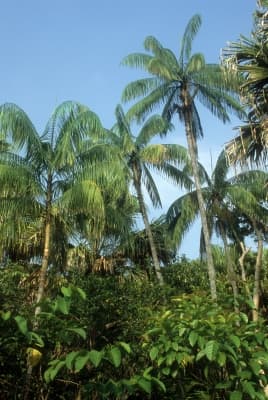
Oncosperma tigillarium
Oncosperma tigillarium
Safety & Hazards
None known
Cultivation Details
Plants succeed at low elevations in moist tropical climates, with or without a dry period. They grow best in areas where the mean annual temperature falls within the range 20 - 30°c, but can tolerate 10 - 35°c[1]. They prefer a mean annual rainfall in the range 1,500 - 3,000mm, tolerating 1,000 - 3,500mm[1]. They can tolerate a dry season, but even then the driest month should have 25mm or more rain[2]. Plants grow well in full sun, even when small[2], but can also succeed in light shade[1]. Succeeds in most soils[1]. Plants can tolerate at least some maritime exposure with salt spray and somewhat saline soil conditions[2, 3]. Prefers a pH in the range 6 - 6.5, but tolerates 5.5 - 7[1].
Propagation
Seed - pre-soak for 24 hours in warm water and sow in containers. Fresh seed can germinate in under 2 months[2]. Cite as: Tropical Plants Database, Ken Fern. tropical.theferns.info. 2026-02-20. <tropical.theferns.info/viewtropical.php?id=Oncosperma+tigillarium>
Pollinators
Data unavailable
References
- [1]Ecocrop — http://ecocrop.fao.org/ecocrop/srv/en/home ↩︎Basic information on a wide range of useful plants, plus details of environmental needs where available.
- [2]Palms of the World — Blombery. A. & Rodd. T. · Angus and Robertson · 1992 · ISBN 0-207-14848-1 ↩︎An excellent guide, well illustrated, with information on cultivation, uses, habitat etc of almost 200 species of Palms.
- [3]Minor Products of Philippine Forests — Brown. W. H. · Bureau of Forestry, Manilla. · 1920 ↩︎A useful guide to some of the plants of the area, though terse on details. The book is out of copyright and can be legally downloaded from the Internet.
- [4]Cornucopia II — Facciola. S. · Kampong Publications, California. · 1998 · ISBN 0-9628087-2-5 ↩︎The second edition of an excellent guide to the edible uses of plants, though it does not give any details of cultivation etc.
- [5]Sturtevant's Edible Plants of the World. — Hedrick. U. P. · Dover Publications · 1972 · ISBN 0-486-20459-6 ↩︎Lots of entries, quite a lot of information in most entries and references.
- [6]Medicinal Plants of Kadazandusun, Malaysia. — Julius Kulip; Sining Unchi; George Majawat. · Forestry Research Centre, Sabah · http://www.borneofocus.com/saip/vaic/R&D/article13.htm ↩︎A report from the Forestry Research Centre at Sabah, listing the plants that are used medicinally by local peoples. Very brief list of Botanical names and uses. Also published on the internet.
- [7]Dictionary of Economic Plants. — Uphof. J. C. Th. · Weinheim · 1959 · ISBN - ↩︎An excellent and very comprehensive guide but it only gives very short descriptions of the uses without any details of how to utilize the plants. Not for the casual reader.
- [8]Five hundred plant species in Gunung Halimun Salak National Park, West Java — Hari Priyadi et al · Center for International Forestry Research; Indonesia. · 2010 · http://www.cifor.cgiar.org · ISBN 978-602-8693-22-6 ↩︎Brief details of the uses of 500 Indonesian plants. It is available as a PDF document to download from the internet.