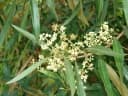
Olea europaea cuspidata
Olea europaea cuspidata
Safety & Hazards
None known
Cultivation Details
A plant of moist to semi-arid areas of the tropics and subtropics, where it can be found at elevations up to 2,700 metres[1]. Plants grow best in areas where the mean annual temperature falls within the range 22 - 28°c, though they can tolerate 15 - 35°c[1]. Plants can resist some frost - dormant plants are killed by temperatures of -4°c, whilst young growth can be damaged at -1°c[1]. Prefers a mean annual rainfall in the range 500 - 1,000mm, tolerating 300 - 1,500mm[1]. Requires a sunny position, succeeding in most soils so long as they are well-drained[1]. Plants can succeed in soils of low fertility[1]. Established plants are very drought tolerant[2, 1]. Prefers a pH in the range 6.5 - 7.5, but tolerates 6 - 8.5[1].
Propagation
Seed - Cite as: Tropical Plants Database, Ken Fern. tropical.theferns.info. 2026-02-20. <tropical.theferns.info/viewtropical.php?id=Olea+europaea+cuspidata>
Pollinators
Data unavailable
References
- [1]Ecocrop — http://ecocrop.fao.org/ecocrop/srv/en/home ↩︎Basic information on a wide range of useful plants, plus details of environmental needs where available.
- [2]World Agroforesty Centre — http://www.worldagroforestry.org/ ↩︎An excellent online database of a huge range of trees giving very good information on each plant - its uses, ecology, identity, propagation, pests etc.
- [3]A Manual of Indian Timbers. — Gamble. J. S. · Bishen Singh Mahendra Pal Singh · 1972 · ISBN - ↩︎First written in the 19th century, but still a classic, giving a lot of information on the uses and habitats of Indian trees. Not for the casual reader.
- [4]Cornucopia II — Facciola. S. · Kampong Publications, California. · 1998 · ISBN 0-9628087-2-5 ↩︎The second edition of an excellent guide to the edible uses of plants, though it does not give any details of cultivation etc.
- [5]Economic Products of India. Volume 1. — Watt. G. · Government of India: Calcutta. · 1883 ↩︎Although over 100 years old, it still contains a wealth of information on useful plants. Many of the botanical names have been changed since then, so you have to check for up to date names. The book can be downloaded from the Internet.
- [6]Field Guide to the Moist Forest Trees of Tanzania. — Lovett J.C.; Ruffo C.K.; Gereau R.E.; Taplin J.R.D · Frontier · http://www.york.ac.uk/res/celp/webpages/projects/ecology/tree%20guide/introduction.htm · ISBN 1-873070-33-0 ↩︎A lovely little book giving a basic identification guide to more than 650 species of trees growing in Tanzania. It is also available to view on the internet.
- [7]Ethnobotanical Studies of Useful Trees of District Kotli, Azad Jammu and Kashmir — Muhammad Ajaib & Zaheer-Ud-Din Khan · 2014 · ISBN 2313-206X ↩︎