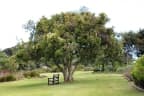
Olea capensis
Olea capensis
Safety & Hazards
None known
Cultivation Details
A plant of tropical and subtropical areas, where it is found at elevations from 800 - 2,600 metres[1]. It grows best in areas where the mean annual temperature falls within the range 14 - 18°c, but can tolerate 10 - 30°c[1]. It prefers a mean annual rainfall of 800 - 1,200mm with a distinct dry season, tolerating a rainfall of 700 - 1,500mm[1]. Requires a sunny position and a well-drained soil[1]. Plants can tolerate some shade[2]. Prefers a pH in the range 5.5 - 7, but tolerates 5 - 7.5[1]. Growth is reported fast in young plants but much slower in older ones. Over the first 4 years a mean annual height of 1.1 metres has been reported[2]. Flowering in profusion apparently takes place only at irregular intervals of up to 7 years in the late dry season[2]. The fruits take about 6 months to ripen[2]. This species has been divided into 3 subspecies:- Ssp. Macrocarpa. The fruits are oblong to elliptic, up to 2 x 1 cm; flowers in lax heads. Ssp. Capensis. The fruits are almost spherical to oblong elliptic, up to 1 cm long; flowers in dense heads and leaves very variable, apex often rounded; branchlets grey to greyish-brown. Ssp. Enervis. The leaves are usually broadly elliptic, apex tapering; branchlets grey to whitish[1].
Propagation
Seed - best sown as soon as it is ripe, otherwise there can be problems with dormancy[2]. Fresh, mature, healthy seed usually germinates reasonably well, though the germination percentage tends to be low, at 30 - 40%, and uneven- it is usually extended over a period of 2 - 3 months but even in fresh seed can take as long as 2 years from sowing[2]. He seed is collected and cleaned of all pulp - soaking in water for 2 days makes removal easier[2]. Cite as: Tropical Plants Database, Ken Fern. tropical.theferns.info. 2026-02-20. <tropical.theferns.info/viewtropical.php?id=Olea+capensis>
Pollinators
Data unavailable
References
- [1]Ecocrop — http://ecocrop.fao.org/ecocrop/srv/en/home ↩︎Basic information on a wide range of useful plants, plus details of environmental needs where available.
- [2]World Agroforesty Centre — http://www.worldagroforestry.org/ ↩︎An excellent online database of a huge range of trees giving very good information on each plant - its uses, ecology, identity, propagation, pests etc.
- [3]Field Guide to the Moist Forest Trees of Tanzania. — Lovett J.C.; Ruffo C.K.; Gereau R.E.; Taplin J.R.D · Frontier · http://www.york.ac.uk/res/celp/webpages/projects/ecology/tree%20guide/introduction.htm · ISBN 1-873070-33-0 ↩︎A lovely little book giving a basic identification guide to more than 650 species of trees growing in Tanzania. It is also available to view on the internet.
- [4]Dictionary of Economic Plants. — Uphof. J. C. Th. · Weinheim · 1959 · ISBN - ↩︎An excellent and very comprehensive guide but it only gives very short descriptions of the uses without any details of how to utilize the plants. Not for the casual reader.
- [5]Tropical Timbers of the World. Ag. Handbook No. 607. — Chudnoff. Martin. · USDA Forest Service. Wisconsin. · 1984 ↩︎Terse details on the properties of the wood of almost 400 species of trees from the Tropics.