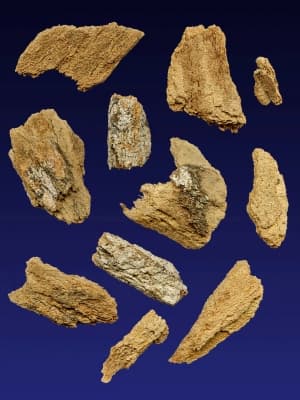
Okoubaka aubrevillei
Okoubaka aubrevillei
Safety & Hazards
The bark is used as a fish poison[1].
Cultivation Details
Natural regeneration is poor, because the fruits and seeds are eaten by porcupines[1]. In southern Nigeria, Okoubaka aubrevillei is an important tree in religious ceremonies[1]. It is considered to be a mystery plant in Cote D'Ivoire, and nobody would fell it. It belongs to a family of plants that includes many parasitic and hemiparasitic species and is said to kill trees around its growth place, though it has not been proven to be parasitic[2]. Okoubaka aubrevillei is a hemi-parasitic plant. Within 6 months after germination, when nutrient reserves in the seed become depleted, the roots attach themselves to those of nearby plants by means of haustoria. However, one year after germination no differences were found in growth and foliar nutrient concentrations between plants growing with and those without hosts. The hosts, however, showed increased mortality or reduced growth. Hence, the apparent benefit which this species gains from the parasitic association is killing potential competitors for water, light and nutrients. The only tree species surviving close to it are Myrianthus arboreus and Musanga cecropioides[1].
Propagation
Seed - germination rates of 60 - 100% have been recorded[1]. Attempts have been made to cultivate this species. After germination, the seedlings were transplanted in rows 4 metres apart, at a distance of 2 metres within the rows. Between the rows, Millettia laurentii was planted to act as a host. After about 10 years, 54% of the plants had survived and had reached an average height of 4.2 metres, with a maximum height of 8.6 metres. The host plant, Millettia laurentii, grew well for the first 6 years, but then started dying[1]. Cite as: Tropical Plants Database, Ken Fern. tropical.theferns.info. 2026-02-20. <tropical.theferns.info/viewtropical.php?id=Okoubaka+aubrevillei>
Pollinators
Data unavailable
References
- [1]Protabase - Plant Resources of Tropical Africa. — http://www.prota.org ↩︎An excellent on-line database with detailed information on over 3,200 species of useful plants of Africa.
- [2]African Flowering Plants Database — Conservatoire et Jardin Botaniques. · http://www.ville-ge.ch/musinfo/bd/cjb/africa/recherche.php ↩︎Contains information on over 150,000 plant names (including synonyms) giving a description and habitat, plus a distribution map.
- [3]The Useful Plants of West Tropical Africa. — Burkil. H. M. · Royal Botanic Gardens; Kew. · 1985 - 2004 ↩︎Brief descriptions and details of the uses of over 4,000 plants. A superb, if terse, resource, it is also available electronically on the Web - see http://www.aluka.org/