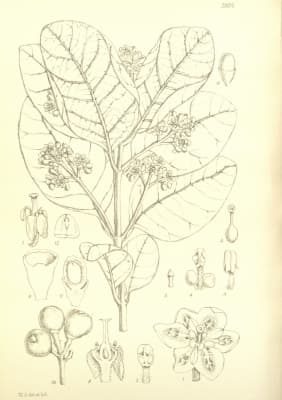
Ocotea usambarensis
Ocotea usambarensis
Safety & Hazards
None known
Cultivation Details
A plant of the moist tropics, where it is found at elevations from 900 - 3,000 metres[1]. It is found in areas where the mean annual rainfall ranges from 1,200 - 2,450mm, often with 2 - 3 dry months[1]. It prefers a mean annual temperature in the range of 15 - 20°c, but tolerates 8 - 30°c[2]. Grows best in a sunny position[2]. Prefers a deep, fertile soil with good drainage[1]. Prefers a pH in the range 5.5 - 6, tolerating 5 - 6.5[2]. Records of growth rates are contradictory. Growth rates of up to 2 metres per year have been recorded for young trees, but this seems to be exceptional. In a 75-year-old plantation at 2,450 metres altitude in Kenya, trees were 15 - 29 metres tall, with a bole diameter of 19 - 51cm[1]. In Tanzania 49-year-old trees were 15 - 24.5 metres tall, with a mean bole length of 10 metres and mean bole diameter of 40 - 49cm[1]. Trees may produce fruits in large amounts, but usually only once in 3 - 4 years, so-called mast years[1]. Trees often develop root suckers, though these are often eaten by large animals such as elephants[1]. Under natural conditions, the tree regenerates mainly by suckers because undamaged seed is uncommon. After natural breakdown of an old tree, the gap is first filled by fast-growing pioneer species, in the shade of which the Ocotea usambarensis suckers can establish, and after death of the pioneer species they can develop into new trees[1]. Regeneration by suckering and coppicing is high after clear felling[1]. Trees can be managed by coppicing, to which they respond well at any age[1].
Propagation
Seed - best sown as soon as ripe[1]. Seeds should be cleaned from the surrounding pulp before sowing by rubbing in water[1]. The germination rate is often low, up to 45%. Seeds usually start germinating in 30 - 45 days, but germination may take up to 90 days[1]. Propagation by root suckers is easy; these are often produced abundantly[1]. Cite as: Tropical Plants Database, Ken Fern. tropical.theferns.info. 2026-02-20. <tropical.theferns.info/viewtropical.php?id=Ocotea+usambarensis>
Pollinators
Data unavailable
References
- [1]Protabase - Plant Resources of Tropical Africa. — http://www.prota.org ↩︎An excellent on-line database with detailed information on over 3,200 species of useful plants of Africa.
- [2]Ecocrop — http://ecocrop.fao.org/ecocrop/srv/en/home ↩︎Basic information on a wide range of useful plants, plus details of environmental needs where available.
- [3]Flora Zambesiaca — http://apps.kew.org/efloras/fz/intro.html ↩︎An excellent online flora of plants from the Zambezi River basin. It lists a number of the plant uses as well as the habitats and botanical descriptions of the plants.
- [4]Tropical Timbers of the World. Ag. Handbook No. 607. — Chudnoff. Martin. · USDA Forest Service. Wisconsin. · 1984 ↩︎Terse details on the properties of the wood of almost 400 species of trees from the Tropics.
- [5]Field Guide to the Moist Forest Trees of Tanzania. — Lovett J.C.; Ruffo C.K.; Gereau R.E.; Taplin J.R.D · Frontier · http://www.york.ac.uk/res/celp/webpages/projects/ecology/tree%20guide/introduction.htm · ISBN 1-873070-33-0 ↩︎A lovely little book giving a basic identification guide to more than 650 species of trees growing in Tanzania. It is also available to view on the internet.