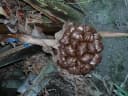
Nypa fruticans
Nypa fruticans
Safety & Hazards
None known
Cultivation Details
Nypa fruticans is a plant of low elevations in the moist tropics. It grows best in areas where annual daytime temperatures are within the range 23 - 27°c, but can tolerate 20 - 35°c[1]. It prefers a mean annual rainfall in the range 2,000 - 2,800mm, but tolerates 1,500 - 3,500mm[1]. Grows best in a sunny position[1]. Plants are only found in tidal mudflats of the moist tropics in the wild, though they have also been successfully cultivated in swampy ground some distance from the sea[2]. Prefers a pH in the range 6.5 - 7.5, tolerating 5.5 - 8.5[1]. Nipa palm is probably the oldest palm species, with evidence to show that it had a pantropical distribution 13 - 63 million years ago[3]. It is considered an advanced palm species, and it has been suggested that it could be related to two genera in the Pandanaceae, Pandanus and Sararanga[3]. The first flowering occurs 3 - 4 years after germination[3]. The plant can be tapped for its sap by the time of the second flowering[1].
Propagation
Seed - there is little information on germination of this plant. It seems likely that the seed benefits from a period of being immersed in the sea since germinating seeds are often washed up on shore in the areas where it grows[2]. The seed needs to be fresh and also needs to be kept in warm and permanently moist conditions if it is to germinate[4]. Cite as: Tropical Plants Database, Ken Fern. tropical.theferns.info. 2026-02-20. <tropical.theferns.info/viewtropical.php?id=Nypa+fruticans>
Pollinators
Flies
References
- [1]Ecocrop — http://ecocrop.fao.org/ecocrop/srv/en/home ↩︎Basic information on a wide range of useful plants, plus details of environmental needs where available.
- [2]Palms of the World — Blombery. A. & Rodd. T. · Angus and Robertson · 1992 · ISBN 0-207-14848-1 ↩︎An excellent guide, well illustrated, with information on cultivation, uses, habitat etc of almost 200 species of Palms.
- [3]World Agroforesty Centre — http://www.worldagroforestry.org/ ↩︎An excellent online database of a huge range of trees giving very good information on each plant - its uses, ecology, identity, propagation, pests etc.
- [4]The New RHS Dictionary of Gardening. 1992. — Huxley. A. · MacMillan Press · 1992 · ISBN 0-333-47494-5 ↩︎Excellent and very comprehensive, though it contains a number of silly mistakes. Readable yet also very detailed.
- [5]Plant Resources of Southeast Asia — http://proseanet.org/ ↩︎Lots of information on the uses of the plants of SE Asia.
- [6]The Useful Plants of the Island of Guam — Safford W.E. · Smithsonian Institute; Washington. · 1905 · http://www.biodiversitylibrary.org/ ↩︎A very comprehensive, if rather dated, guide to the plants of Guam. It can be downloaded from the Internet.
- [7]IUCN Red List of Threatened Species — http://www.iucnredlist.org/ ↩︎A list of plants under threat and facing possible extinction, usually with brief details of the threats and information on habitat.
- [8]Cornucopia II — Facciola. S. · Kampong Publications, California. · 1998 · ISBN 0-9628087-2-5 ↩︎The second edition of an excellent guide to the edible uses of plants, though it does not give any details of cultivation etc.
- [9]Dictionary of Economic Plants. — Uphof. J. C. Th. · Weinheim · 1959 · ISBN - ↩︎An excellent and very comprehensive guide but it only gives very short descriptions of the uses without any details of how to utilize the plants. Not for the casual reader.