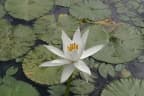
Nymphaea lotus
Nymphaea lotus
Safety & Hazards
None known
Cultivation Details
Succeeds in tropical and subtropical areas[1]. Grows best in a rich soil in still water at least 30cm deep[1]. Requires a position in full sun[1]. If the soil is too rich, or the water too deep, then flowering can be inhibited[1].
Propagation
Seed - needs to be kept moist prior to sowing. Sow seed, together with the surrounding pulp, in pots covered by about 25mm of water at 23 - 27c[2]. Prick out into individual pots when the first floating leaves appear and gradually raise the water level as they grow[2]. Division, or the removal of a portion of the rhizome with a sprouting eye[2]. Pot up into a small immersed pot and pot on as the plant grows until the roots fill a 10cm pot, by which time it is large enough to plant out[2]. Cite as: Tropical Plants Database, Ken Fern. tropical.theferns.info. 2026-02-20. <tropical.theferns.info/viewtropical.php?id=Nymphaea+lotus>
Pollinators
Data unavailable
References
- [1]Encyclopaedia of Herbs and their Uses. — Bown. D. · Dorling Kindersley, London. · 1995 · ISBN 0-7513-020-31 ↩︎A very well presented and informative book on herbs from around the globe. Plenty in it for both the casual reader and the serious student. Just one main quibble is the silly way of having two separate entries for each plant.
- [2]The New RHS Dictionary of Gardening. 1992. — Huxley. A. · MacMillan Press · 1992 · ISBN 0-333-47494-5 ↩︎Excellent and very comprehensive, though it contains a number of silly mistakes. Readable yet also very detailed.
- [3]Flora of China — Missouri Botanical Garden Press; St. Louis. · 1994 · http://flora.huh.harvard.edu/china/ ↩︎An excellent, comprehensive resource in 25 volumes. In addition to the botanical information the flora also gives basic information on habitat and some uses. An on-line version is also available.
- [4]Edible Wild Plants of Tanzania — Ruffo, C.K.: Birnie, A. & Tengnas, B. · Regional Land Management Unit; Nairobi. · 2002 · ISBN 9966-896-60-0 ↩︎A very well presented, simple guide to growing and utilizing wild food plants in Tanzania, with line drawings of each plant, a description, habitat and range, non-food as well as food uses, plus basic information on growing the plants.
- [5]Cornucopia II — Facciola. S. · Kampong Publications, California. · 1998 · ISBN 0-9628087-2-5 ↩︎The second edition of an excellent guide to the edible uses of plants, though it does not give any details of cultivation etc.