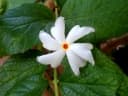
Nyctanthes arbor-tristis
Nyctanthes arbor-tristis
Safety & Hazards
The bark contains a glycoside and alkaloids, suspected of being poisonous to animals and humans[1].
Cultivation Details
A plant of tropical and subtropical areas, where it is found at elevations from sea level to 1,500 metres[2]. It tolerates a wide range of rainfall patterns, from seasonal to non-seasonal[2]. The plant tolerates moderate shade[2]. The flowers open at sunset and usually wither after sunrise the next day[2]. The shrub coppices readily[2]. Some cultivars with ornamental value have been described in India, for instance 'Karna-phool' and 'Seeya Shrinagar'[2].
Propagation
Coral jasmine is easily propagated by seeds or cuttings[2]. Cite as: Tropical Plants Database, Ken Fern. tropical.theferns.info. 2026-02-20. <tropical.theferns.info/viewtropical.php?id=Nyctanthes+arbor-tristis>
Pollinators
Data unavailable
References
- [1]Plant Resources of Southeast Asia — http://proseanet.org/ ↩︎Lots of information on the uses of the plants of SE Asia.
- [2]World Agroforesty Centre — http://www.worldagroforestry.org/ ↩︎An excellent online database of a huge range of trees giving very good information on each plant - its uses, ecology, identity, propagation, pests etc.
- [3]Mansfeld's Database of Agricultural and Horticultural Plants — http://mansfeld.ipk-gatersleben.de/pls/htmldb_pgrc/f?p=185:3:4292127278597336 ↩︎Terse details of a huge range of useful plants.
- [4]Cornucopia II — Facciola. S. · Kampong Publications, California. · 1998 · ISBN 0-9628087-2-5 ↩︎The second edition of an excellent guide to the edible uses of plants, though it does not give any details of cultivation etc.
- [5]Economic Products of India. Volume 1. — Watt. G. · Government of India: Calcutta. · 1883 ↩︎Although over 100 years old, it still contains a wealth of information on useful plants. Many of the botanical names have been changed since then, so you have to check for up to date names. The book can be downloaded from the Internet.