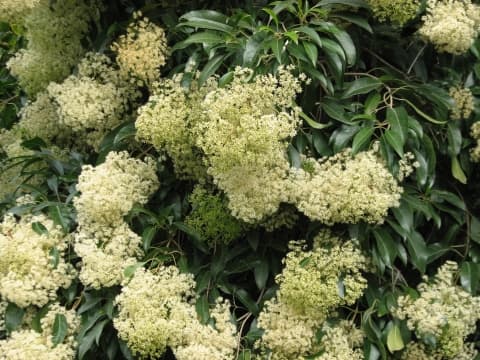
Nuxia floribunda
Nuxia floribunda
Safety & Hazards
None known
Cultivation Details
The plant is relatively sensitive to frost[1]. Succeeds in full sun and in partly shady positions[1, 2]. Requires a deep, rich, moist soil for best growth[1, 2]. Intolerant of droughts[1]. A moderately fast-growing plant when planted in good, moist soils[1]. The root system is not aggressive or invasive, allowing for planting in close proximity to roads, buildings and paving[1].
Propagation
Seed - The seeds which are very small in size should be scattered evenly over the surface of the medium and very lightly covered with fine river sand. Place in a warm, brightly lit position and keep moist. Germination times generally vary between 6 and 12 weeks. According to Von Breitenbach (1965) the germinative capacity of the seed may however be very low[1]. Propagation from cuttings involves selecting healthy semi-hardwood or hardwood cuttings up to 100 mm in length (Venter & Venter 2002). These should be inserted into a well-drained growing medium for rooting, suitable media being river sand or equal parts of river sand and compost mix[1]. Cite as: Tropical Plants Database, Ken Fern. tropical.theferns.info. 2026-02-20. <tropical.theferns.info/viewtropical.php?id=Nuxia+floribunda>
Pollinators
Bees, Insects, Self
References
- [1]PlantZAfrica.com — http://www.plantzafrica.com ↩︎An excellent site giving detailed descriptions and uses of many S. African plants.
- [2]Desert Tropicals — http://www.desert-tropicals.com/ ↩︎The main focus of the site is succulent plants, but it also contains information on a wide range of other species. Usually at least one good photograph, plus basic information about the plant and its cultivation.
- [3]Field Guide to the Moist Forest Trees of Tanzania. — Lovett J.C.; Ruffo C.K.; Gereau R.E.; Taplin J.R.D · Frontier · http://www.york.ac.uk/res/celp/webpages/projects/ecology/tree%20guide/introduction.htm · ISBN 1-873070-33-0 ↩︎A lovely little book giving a basic identification guide to more than 650 species of trees growing in Tanzania. It is also available to view on the internet.
- [4]Flora Zambesiaca — http://apps.kew.org/efloras/fz/intro.html ↩︎An excellent online flora of plants from the Zambezi River basin. It lists a number of the plant uses as well as the habitats and botanical descriptions of the plants.