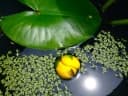
Nuphar advena
Nuphar advena
Safety & Hazards
None known
Cultivation Details
Nuphar advena is a plant mainly of the temperate zone, moving into the subtropics and the tropics in Cuba. It grows best in areas where annual daytime temperatures are within the range 14 - 30°c, but can tolerate 10 - 36°c[1]. When dormant, the plant can survive temperatures down to about -20°c, but young growth can be severely damaged at 0°c[1]. It prefers a mean annual rainfall in the range 700 - 1,500mm, but tolerates 500 - 1,700mm[1]. A water plant requiring a rich soil and a sunny position. It also succeeds in light shade[2]. It is best if grown in still water that is up to 60cm deep but it also tolerates slow moving water[2]. Prefers a pH in the range 5 - 7.5, tolerating 4.5 - 8[1]. Nuphar advena is extremely variable and intergrades with Nuphar orbiculata , Nuphar ulvacea , and Nuphar sagittifolia in areas where their ranges overlap[3].
Propagation
Seed - sow as soon as it is ripe in a greenhouse in pots submerged under 25mm of water. Prick out into individual pots as soon as the first true leaf appears and grow them on in water in a greenhouse for at least two years before planting them out in late spring. The seed is collected by wrapping the developing seed head in a muslin bag to avoid the seed being lost. Harvest it 10 days after it sinks below the soil surface or as soon as it reappears[2]. Division in May. Each portion must have at least one eye. Submerge in pots in shallow water until established[4]. Cite as: Temperate Plants Database, Ken Fern. temperate.theferns.info. 2026-02-21. <temperate.theferns.info/plant/Nuphar+advena>
Pollinators
Flies, Beetles
References
- [1]Ecocrop — http://ecocrop.fao.org/ecocrop/srv/en/home ↩︎Basic information on a wide range of useful plants, plus details of environmental needs where available.
- [2]The New RHS Dictionary of Gardening. 1992. — Huxley. A. · MacMillan Press · 1992 · ISBN 0-333-47494-5 ↩︎Excellent and very comprehensive, though it contains a number of silly mistakes. Readable yet also very detailed.
- [3]Flora of N. America — http://flora.huh.harvard.edu/fna/ ↩︎An on-line version of the flora with an excellent description of the plant including a brief mention of plant uses.
- [4]Complete Guide to Water Plants. — Muhlberg. H. · E. P. Publishing Ltd. · 1982 · ISBN 0-7158-0789-7 ↩︎Deals with a wide range of plants for temperate areas (and indoor aquaria) with quite a lot of information on cultivation techniques.
- [5]RHS Dictionary of Plants plus Supplement. 1956 — F. Chittendon. · Oxford University Press · 1951 · ISBN - ↩︎Comprehensive listing of species and how to grow them. Somewhat outdated, it has been replaced in 1992 by a new dictionary (see [ 200 ]).
- [6]Gray's Manual of Botany.Eighth Edition — Fernald. M. L. · American Book Co.; New York · 1950 · ISBN 0442222505 ↩︎A bit dated but a good and concise flora of the eastern part of N. America.
- [7]Sturtevant's Edible Plants of the World. — Hedrick. U. P. · Dover Publications · 1972 · ISBN 0-486-20459-6 ↩︎Lots of entries, quite a lot of information in most entries and references.
- [8]A Field Guide to N. American Edible Wild Plants. — Elias. T. and Dykeman. P. · Van Nostrand Reinhold · 1982 · ISBN 0442222009 ↩︎Very readable.
- [9]Food Plants of the N. American Indians. — Yanovsky. E. · U.S. Depf of Agriculture. · ISBN - ↩︎A comprehensive but very terse guide. Not for the casual reader.
- [10]Cornucopia - A Source Book of Edible Plants. — Facciola. S. · Kampong Publications · 1990 · ISBN 0-9628087-0-9 ↩︎Excellent. Contains a very wide range of conventional and unconventional food plants (including tropical) and where they can be obtained (mainly N. American nurseries but also research institutes and a lot of other nurseries from around the world.
- [11]Edible Native Plants of the Rocky Mountains. — Harrington. H. D. · University of New Mexico Press · 1967 · ISBN 0-8623-0343-9 ↩︎A superb book. Very readable, it gives the results of the authors experiments with native edible plants.
- [12]Earth Medicine, Earth Food. — Weiner. M. A. · Ballantine Books · 1980 · ISBN 0-449-90589-6 ↩︎A nice book to read though it is difficult to look up individual plants since the book is divided into separate sections dealing with the different medicinal uses plus a section on edible plants. Common names are used instead of botanical.
- [13]Native American Ethnobotany — Moerman. D. · Timber Press. Oregon. · 1998 · ISBN 0-88192-453-9 ↩︎Very comprehensive but terse guide to the native uses of plants. Excellent bibliography, fully referenced to each plant, giving a pathway to further information. Not for the casual reader.
- [14]A Modern Herbal. — Grieve. · Penguin · 1984 · ISBN 0-14-046-440-9 ↩︎Not so modern (1930's?) but lots of information, mainly temperate plants.