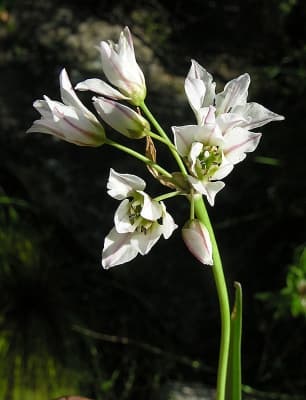
Nothoscordum gracile
Nothoscordum gracile
Safety & Hazards
None known
Cultivation Details
Prefers a light sandy soil in a sunny position[1]. This species reproduces freely when in good growing conditions and has become a weed in some gardens[1, 2]. The flowers open in the late afternoon and have a rich, sweet lily-like perfume[3].
Propagation
Seed - best sown as soon as ripe in a cold frame[4]. Spring sown seed germinates freely[PFAF]. When they are large enough to handle, prick the seedlings out into individual pots and grow them on in the greenhouse for at least their first winter. Plant them out into their permanent positions in spring. Division of offsets after the leaves die down in summer. Larger bulbs can be replanted immediately into their permanent positions. It is best to pot up the smaller bulbs and grow them on for a year before planting them out when dormant in late summer. Cite as: Temperate Plants Database, Ken Fern. temperate.theferns.info. 2026-02-21. <temperate.theferns.info/plant/Nothoscordum+gracile>
Pollinators
Insects
References
- [1]Hardy Bulbs.; Including Half-hardy Bulbs and Tuberous and Fiberous-rooted Plants — Grey. C. H. · Williams & Norgate. · 1938 · ISBN - ↩︎Rather dated now, but an immense work on bulbs for temperate zones and how to grow them. Three large volumes.
- [2]On the Occurrence and Taxonomy of False Garlic - Nothoscordum gracile (Aiton) Stearn (Amaryllidaceae), an Invasive W — Dalavi J. et al · 2022 · http://10.56024/ispm.72.1&2.2022/13-16 ↩︎
- [3]Scented Flora of the World. — Genders. R. · Robert Hale. London. · 1994 · ISBN 0-7090-5440-8 ↩︎An excellent, comprehensive book on scented plants giving a few other plant uses and brief cultivation details. There are no illustrations.
- [4]RHS Dictionary of Plants plus Supplement. 1956 — F. Chittendon. · Oxford University Press · 1951 · ISBN - ↩︎Comprehensive listing of species and how to grow them. Somewhat outdated, it has been replaced in 1992 by a new dictionary (see [ 200 ]).
- [5]The New RHS Dictionary of Gardening. 1992. — Huxley. A. · MacMillan Press · 1992 · ISBN 0-333-47494-5 ↩︎Excellent and very comprehensive, though it contains a number of silly mistakes. Readable yet also very detailed.
- [6]Manual of the Southeastern Flora. — Small J.K. · University of N. Carolina Press. · 1933 · http://www.biodiversitylibrary.org ↩︎Getting rather dated now, an immense work covering the flora of Southeastern N. America. No pictures, it is not for the casual reader. It can be downloaded from the Internet.
- [7]Sturtevant's Edible Plants of the World. — Hedrick. U. P. · Dover Publications · 1972 · ISBN 0-486-20459-6 ↩︎Lots of entries, quite a lot of information in most entries and references.
- [8]Food Plants in the Americas: A Survey of the Domesticated, Cultivated, and Wild Plants Used for Human Food in North, — Kermath B.M.; Bennett B.C.' Pulsipher L.M. · 2014 ↩︎A pre-publication draft of an amazing, on-going work first started in 1985. It contains information on more than 3,900 taxa from the Americas - from Arctic regions to the Tropics
- [9]Tanaka's Cyclopedia of Edible Plants of the World. — Tanaka. T. & Nakao S. · Keigaku Publishing; Tokyo · 1976 · ISBN - ↩︎The most comprehensive list of edible plants I've come across. Only the briefest entry for each species, though, and some of the entries are more than a little dubious. Not for the casual reader.
- [10]Plants for Human Consumption. — Kunkel. G. · Koeltz Scientific Books · 1984 · ISBN 3874292169 ↩︎An excellent book for the dedicated. A comprehensive listing of Latin names with a brief list of edible parts.
- [11]Cornucopia - A Source Book of Edible Plants. — Facciola. S. · Kampong Publications · 1990 · ISBN 0-9628087-0-9 ↩︎Excellent. Contains a very wide range of conventional and unconventional food plants (including tropical) and where they can be obtained (mainly N. American nurseries but also research institutes and a lot of other nurseries from around the world.
- [12]Flora of N. America — http://flora.huh.harvard.edu/fna/ ↩︎An on-line version of the flora with an excellent description of the plant including a brief mention of plant uses.
- [PFAF]Plants for a Future — pfaf.org ↩︎