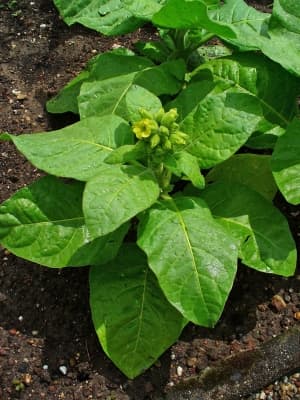
Nicotiana rustica
Nicotiana rustica
Safety & Hazards
All parts of the plant are poisonous[1].
Cultivation Details
Nicotiana rustica is a plant of tropical areas, where it can be found at elevations from sea level to about 1,800 metres[2]. It is also grown in subtropical and warm temperate areas. It grows best in areas where the mean annual temperate falls within the range 15 - 30°c, though it can tolerate 10 - 40°c[2]. It prefers a mean annual rainfall in the range 600 - 700mm, tolerating 500 - 800mm[2]. Prefers a well-drained deep rich moist soil in a sunny position[3, 1]. Prefers a pH in the range 5.5 - 6, but tolerates 5 - 7.5[2]. Most plants are stalk-cut at 100 - 130 days after planting. Only the hookah cultivars in India have their individual leaves harvested[4]. It should be possible to obtain 1.5 - 2 tonnes per hectare of cured leaves[4]. In Pakistan harvested plants of 'white pattar' or 'saffaid' are sun cured for about two weeks and turned once or twice to obtain a relatively light-coloured leaf. Harvested 'naswari' plants are left in the field for about six days to dry partially, before being gathered into heaps, which will be turned several times in the ensuing 1—2 months in a combined curing and fermentation process. The aim here is a dark, strong-smelling, rather thin tobacco. In Algeria harvested plants are wilted for a short period in the field and then air cured under roofed but open structures, often under lean-to roofs against houses or other buildings[4].
Propagation
Seed - surface sow in a warm greenhouse about 10 weeks before the last expected spring frosts. The seed usually germinates in 10 - 20 days at 20°c. Keep the soil moist and pot up as soon as the plants are big enough to handle, planting them out after the last expected frosts. Cite as: Temperate Plants Database, Ken Fern. temperate.theferns.info. 2026-02-21. <temperate.theferns.info/plant/Nicotiana+rustica>
Pollinators
Lepidoptera
References
- [1]The New RHS Dictionary of Gardening. 1992. — Huxley. A. · MacMillan Press · 1992 · ISBN 0-333-47494-5 ↩︎Excellent and very comprehensive, though it contains a number of silly mistakes. Readable yet also very detailed.
- [2]Ecocrop — http://ecocrop.fao.org/ecocrop/srv/en/home ↩︎Basic information on a wide range of useful plants, plus details of environmental needs where available.
- [3]RHS Dictionary of Plants plus Supplement. 1956 — F. Chittendon. · Oxford University Press · 1951 · ISBN - ↩︎Comprehensive listing of species and how to grow them. Somewhat outdated, it has been replaced in 1992 by a new dictionary (see [ 200 ]).
- [4]Plant Resources of Southeast Asia — http://proseanet.org/ ↩︎Lots of information on the uses of the plants of SE Asia.
- [5]Invasive Species Compendium — http://www.cabi.org ↩︎An immense resource - in depth information on over 900 species of invasive plants (it also has information on animals, fungi etc).
- [6]Mansfeld's Database of Agricultural and Horticultural Plants — http://mansfeld.ipk-gatersleben.de/pls/htmldb_pgrc/f?p=185:3:4292127278597336 ↩︎Terse details of a huge range of useful plants.
- [7]Narcotic Plants — Emboden. W. · Studio Vista · 1979 · ISBN 0-289-70864-8 ↩︎A lot of details about the history, chemistry and use of narcotic plants, including hallucinogens, stimulants, inebriants and hypnotics.
- [8]Glossary of Indian Medicinal Plants (Including the Supplement). — Chopra. R. N., Nayar. S. L. and Chopra. I. C. · Council of Scientific and Industrial Research, New Delhi. · 1986 · ISBN - ↩︎Very terse details of medicinal uses of plants with a wide range of references and details of research into the plants chemistry. Not for the casual reader.
- [9]Native American Ethnobotany — Moerman. D. · Timber Press. Oregon. · 1998 · ISBN 0-88192-453-9 ↩︎Very comprehensive but terse guide to the native uses of plants. Excellent bibliography, fully referenced to each plant, giving a pathway to further information. Not for the casual reader.
- [10]Dictionary of Economic Plants. — Uphof. J. C. Th. · Weinheim · 1959 · ISBN - ↩︎An excellent and very comprehensive guide but it only gives very short descriptions of the uses without any details of how to utilize the plants. Not for the casual reader.
- [11]A Weavers Garden — Buchanan. R. · McGraw-Hill Contemporary · 1987 · ISBN 0934026289 ↩︎Covers all aspects of growing your own clothes, from fibre plants to dyes.