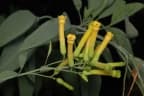
Nicotiana glauca
Nicotiana glauca
Safety & Hazards
The plant contains the toxic alkaloid nicotine. Widely used in all parts of the world as a stimulant, usually by smoking the plant or chewing it, in larger doses nicotine causes vomiting, diarrhoea, slow pulse, dizziness, collapse, and respiratory failure[1].
Cultivation Details
Prefers a well-drained deep rich moist soil in a sunny position[2, 3]. This species is hardy to about -5°c[3]. Plants can survive the winter outdoors in the milder parts of Britain, though they usually act as herbaceous perennials in such conditions[3]. Plants require more than 14 hours daylight per day in order to induce flowering[4].
Propagation
Seed - surface sow in a warm greenhouse about 10 weeks before the last expected spring frosts. The seed usually germinates in 10 - 20 days at 20°c. Keep the soil moist and pot up as soon as the plants are big enough to handle, planting them out after the last expected frosts. Cite as: Temperate Plants Database, Ken Fern. temperate.theferns.info. 2026-02-21. <temperate.theferns.info/plant/Nicotiana+glauca>
Pollinators
Lepidoptera
References
- [1]Poisonous Plants of North Carolina — http://www.ces.ncsu.edu/depts/hort/consumer/poison/poison.htm ↩︎An excellent concise but comprehensive guide to toxic plants that grow in N. Carolina. It lists even those plants that are of very low toxicity, including several well-known food plants such as carrots and potatoes.
- [2]RHS Dictionary of Plants plus Supplement. 1956 — F. Chittendon. · Oxford University Press · 1951 · ISBN - ↩︎Comprehensive listing of species and how to grow them. Somewhat outdated, it has been replaced in 1992 by a new dictionary (see [ 200 ]).
- [3]The New RHS Dictionary of Gardening. 1992. — Huxley. A. · MacMillan Press · 1992 · ISBN 0-333-47494-5 ↩︎Excellent and very comprehensive, though it contains a number of silly mistakes. Readable yet also very detailed.
- [4]A Weavers Garden — Buchanan. R. · McGraw-Hill Contemporary · 1987 · ISBN 0934026289 ↩︎Covers all aspects of growing your own clothes, from fibre plants to dyes.
- [5]Global Invasive Species Database — http://www.issg.org/database/welcome/ ↩︎Very detailed information on almost 400 species (with more being added) of plants that have become weeds in areas outside their native range.
- [6]Mansfeld's Database of Agricultural and Horticultural Plants — http://mansfeld.ipk-gatersleben.de/pls/htmldb_pgrc/f?p=185:3:4292127278597336 ↩︎Terse details of a huge range of useful plants.
- [7]Flora Europaea — ? · Cambridge University Press · 1964 · ISBN - ↩︎An immense work in 6 volumes (including the index). The standard reference flora for Europe, it is very terse though and with very little extra information. Not for the casual reader.
- [8]Native American Ethnobotany — Moerman. D. · Timber Press. Oregon. · 1998 · ISBN 0-88192-453-9 ↩︎Very comprehensive but terse guide to the native uses of plants. Excellent bibliography, fully referenced to each plant, giving a pathway to further information. Not for the casual reader.
- [9]Dictionary of Economic Plants. — Uphof. J. C. Th. · Weinheim · 1959 · ISBN - ↩︎An excellent and very comprehensive guide but it only gives very short descriptions of the uses without any details of how to utilize the plants. Not for the casual reader.
- [10]A Dictionary of Plants Used by Man. — Usher. G. · Constable · 1974 · ISBN 0094579202 ↩︎Forget the sexist title, this is one of the best books on the subject. Lists a very extensive range of useful plants from around the world with very brief details of the uses. Not for the casual reader.