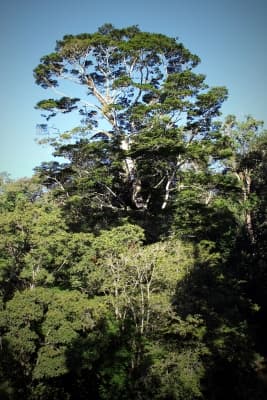
Newtonia buchananii
Newtonia buchananii
Safety & Hazards
None known
Cultivation Details
A plant of the moist to wet tropics, where it can be found at elevations from 600 - 2,200 metres. It occurs in regions with a mean annual rainfall within the range 1,100 - 3,000mm and a mean annual temperature of 17 - 27°c[1, 2]. In general, seedlings grow slowly and have low survival rates. This means that special care is needed in the early years. Direct sowing has been tried in Tanzania, but survival of seedlings was low, up to only 26% after 10 years. Once established however, which is usually after 1 - 3 years, the young trees can grow fairly fast[1]. Locally, trees may be found flowering throughout the year[1]. The winged seeds are mainly dispersed by wind, but distribution by water and birds is also possible[1]. It has been reported that the tree is relatively short lived[1]. Although many species within the family Fabaceae have a symbiotic relationship with soil bacteria, this species is said to be devoid of such a relationship and therefore does not fix atmospheric nitrogen[3].
Propagation
Seed - they do not show any dormancy and usually germinate in 3 - 4 weeks, with up to 70% germination rates and exceptionally to 90%[1]. The seeds lose their viability quickly, and cannot be stored for more than a few weeks at room temperature. They are very susceptible to insect attack[1]. Root suckers can also be used for propagation, and wildlings are occasionally collected for planting[1]. Cite as: Tropical Plants Database, Ken Fern. tropical.theferns.info. 2026-02-20. <tropical.theferns.info/viewtropical.php?id=Newtonia+buchananii>
Pollinators
Bees
References
- [1]Protabase - Plant Resources of Tropical Africa. — http://www.prota.org ↩︎An excellent on-line database with detailed information on over 3,200 species of useful plants of Africa.
- [2]World Agroforesty Centre — http://www.worldagroforestry.org/ ↩︎An excellent online database of a huge range of trees giving very good information on each plant - its uses, ecology, identity, propagation, pests etc.
- [3]Nodulation Plants in GRIN Taxonomy — United States Department of Agriculture · http://www.ars-grin.gov/~sbmljw/cgi-bin/taxnodul.pl?language=en ↩︎An online database listing plants that have either positive or negative reports on root and stem nodulation with nitrogen-fixing bacteria.
- [4]African Flowering Plants Database — Conservatoire et Jardin Botaniques. · http://www.ville-ge.ch/musinfo/bd/cjb/africa/recherche.php ↩︎Contains information on over 150,000 plant names (including synonyms) giving a description and habitat, plus a distribution map.
- [5]The Useful Plants of West Tropical Africa. — Burkil. H. M. · Royal Botanic Gardens; Kew. · 1985 - 2004 ↩︎Brief descriptions and details of the uses of over 4,000 plants. A superb, if terse, resource, it is also available electronically on the Web - see http://www.aluka.org/
- [6]Field Guide to the Moist Forest Trees of Tanzania. — Lovett J.C.; Ruffo C.K.; Gereau R.E.; Taplin J.R.D · Frontier · http://www.york.ac.uk/res/celp/webpages/projects/ecology/tree%20guide/introduction.htm · ISBN 1-873070-33-0 ↩︎A lovely little book giving a basic identification guide to more than 650 species of trees growing in Tanzania. It is also available to view on the internet.