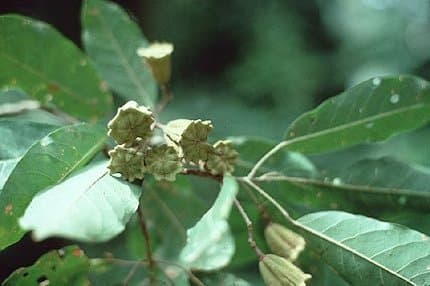
Cultivation Details
Danta is quite a slow-growing tree with saplings reaching a height of up to 1 - 1.5 metres in 4 years[1]. Young trees require the shade of the forest in which to grow, but as they grow larger their light requirement increases with mature trees needing a position with plenty of light[1]. In semi-deciduous forests, danta is usually represented in the upper forest storey by a few individual trees and in the lower canopy by many recruits[1]. Fruits are produced throughout the year except during the dry season. The seeds are dispersed by wind. In mature forest individual trees of up to 125 years old have been recorded[1]. Natural regeneration is best in medium-large gaps in the forest. In large forest clearings, and also in small gaps and especially in dense forest, regeneration is poorer[1]. Burning seems to have a negative effect on regeneration[1]. The tree is not grown in plantations due to its shade-demanding nature when young and comparatively low growth rates[1]. Freshly cut logs sink in water and cannot be transported by river[1].
Propagation
Seed - germination takes 7 - 25 days, and the germination rate is about 75%. Light shade seems to be needed for germination. Cite as: Tropical Plants Database, Ken Fern. tropical.theferns.info. 2026-02-20. <tropical.theferns.info/viewtropical.php?id=Nesogordonia+kabingaensis>
Pollinators
Data unavailable
References
- [1]Protabase - Plant Resources of Tropical Africa. — http://www.prota.org ↩︎An excellent on-line database with detailed information on over 3,200 species of useful plants of Africa.