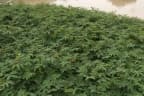
Neptunia oleracea
Neptunia oleracea
Safety & Hazards
None known
Cultivation Details
A plant of the hot and humid, lowland tropics, where it is found at elevations up to 300 metres[1]. It grows best in areas where annual daytime temperatures are within the range 25 - 35°c, but can tolerate 15 - 38°c[2]. When dormant, the plant can survive temperatures down to about 5°c[2]. It prefers a mean annual rainfall in the range 1,500 - 2,000mm, but tolerates 1,000 - 4,000mm[2]. Succeeds along the muddy edges of water or in still or slowly-flowing water. The plant prefers 30 - 80 cm depth of slow-moving water, and a position in full sun[1]. Prefers a pH in the range 5 - 6.5, tolerating 4.5 - 7[2]. A fast-growing plant, under favourable conditions young shoots may elongate at a rate of 5 - 7cm per day[2]. A perennial plant, but it is sometimes treated as an annual in cultivation. Its cropping period is 4 - 6 months[2]. Yields of 30,000 - 50,000 shoots per hectare for each harvest have been reported[2]. This species has a symbiotic relationship with certain soil bacteria, these bacteria form nodules on the roots and fix atmospheric nitrogen. Some of this nitrogen is utilized by the growing plant but some can also be used by other plants growing nearby[3].
Propagation
Seed - Cuttings - these are usually obtained by simply dethatching pieces of stem that have already rooted into the water[3]. Cite as: Tropical Plants Database, Ken Fern. tropical.theferns.info. 2026-02-20. <tropical.theferns.info/viewtropical.php?id=Neptunia+oleracea>
Pollinators
Data unavailable
References
- [1]Plant Resources of Southeast Asia — http://proseanet.org/ ↩︎Lots of information on the uses of the plants of SE Asia.
- [2]Ecocrop — http://ecocrop.fao.org/ecocrop/srv/en/home ↩︎Basic information on a wide range of useful plants, plus details of environmental needs where available.
- [3]The New RHS Dictionary of Gardening. 1992. — Huxley. A. · MacMillan Press · 1992 · ISBN 0-333-47494-5 ↩︎Excellent and very comprehensive, though it contains a number of silly mistakes. Readable yet also very detailed.
- [4]Cornucopia II — Facciola. S. · Kampong Publications, California. · 1998 · ISBN 0-9628087-2-5 ↩︎The second edition of an excellent guide to the edible uses of plants, though it does not give any details of cultivation etc.
- [5]IUCN Red List of Threatened Species — http://www.iucnredlist.org/ ↩︎A list of plants under threat and facing possible extinction, usually with brief details of the threats and information on habitat.
- [6]World Agroforesty Centre — http://www.worldagroforestry.org/ ↩︎An excellent online database of a huge range of trees giving very good information on each plant - its uses, ecology, identity, propagation, pests etc.
- [7]Dictionary of Economic Plants. — Uphof. J. C. Th. · Weinheim · 1959 · ISBN - ↩︎An excellent and very comprehensive guide but it only gives very short descriptions of the uses without any details of how to utilize the plants. Not for the casual reader.