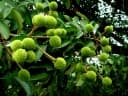
Nephelium ramboutan-ake
Nephelium ramboutan-ake
Safety & Hazards
None known
Cultivation Details
Pulasan grows best in the lowland humid tropics at an elevation below 600 metres. It grows best in areas where annual daytime temperatures are within the range 26 - 32°c, but can tolerate 18 - 38°c[1]. The plant cannot tolerate frost. It prefers a mean annual rainfall in the range 2,000 - 3,000mm, but tolerates 1,350 - 4,100mm[1]. Grows best in a sunny position, tolerating some shade[1]. Prefers a sand or clay soil[2]. Succeeds in most well-drained soils[1]. Prefers a pH in the range 5 - 5.8, tolerating 4.3 - 8[1]. There are some named varieties[3, 4]. Some of the varieties bear parthenocarpic fruit[5]. Trees are usually dioecious[6], but some cultivars are females that also produce a few male flowers (up to 0.5%) and, with adequate bees and other pollinators present, these are sufficient for fertilization to occur[2, 7]. Being overshadowed by good rambutan cultivars, this species has little prospect of being develop for commercial cultivation[4]. However, it is a good potential genetic source in breeding programmes with the rambutan[4].
Propagation
Seed - it has a very short viability and so needs to be sown as soon as it is extracted from the fruit[2]. Wash the seed first to remove traces of the fruit[2]. Sow the seed in containers or in a nursery seedbed in light shade - germination should take place in 7 - 20 days[7]. Properly cared for, the seedlings grow rapidly[8]. They quickly produce a large root system and so need to be planted out into their permanent positions when still young[8]. Layering. Grafting. Cite as: Tropical Plants Database, Ken Fern. tropical.theferns.info. 2026-02-20. <tropical.theferns.info/viewtropical.php?id=Nephelium+ramboutan-ake>
Pollinators
Bees, Insects
References
- [1]Ecocrop — http://ecocrop.fao.org/ecocrop/srv/en/home ↩︎Basic information on a wide range of useful plants, plus details of environmental needs where available.
- [2]World Agroforesty Centre — http://www.worldagroforestry.org/ ↩︎An excellent online database of a huge range of trees giving very good information on each plant - its uses, ecology, identity, propagation, pests etc.
- [3]Cornucopia II — Facciola. S. · Kampong Publications, California. · 1998 · ISBN 0-9628087-2-5 ↩︎The second edition of an excellent guide to the edible uses of plants, though it does not give any details of cultivation etc.
- [4]Under-Utilized Tropical Fruits of Thailand. RAP — Suranant Subhadrabandhu · F. A. O., The United Nations, Bangkok. · 2001 · http://www.fao.org/3/a-ab777e.pdf ↩︎A detailed report on 35 fruit species that could have potential for increased production in Thailand. The report can be downloadd as a PDF from the internet.
- [5]Perennial Edible Fruits of the Tropics : an Inventory — Martin, F. W.; Campbell, C. W.; Rubertbe, R. M. · U.S. Dept. of Agriculture, Agricultural Research Service · 1987 ↩︎A booklet giving terse details of almost 300 species of edible fruits, plus regional lists of Botanical and Common names for over 2,500 less well-known edible fruits of the tropics.
- [6]Flora Malesiana Series 1 — Various · Nationaal Herbarium Nederiand, Universiteit Leiden branch · http://www.archive.org ↩︎A massive treatment of the plants of the Malaysian Archipelago. Much of it has been made available to download from the Internet
- [7]Plant Resources of Southeast Asia — http://proseanet.org/ ↩︎Lots of information on the uses of the plants of SE Asia.
- [8]Tropical Food Gardens — Norrington. L. · Bloomings Books (Melbourne) · 2001 · ISBN 1-876473-41-x ↩︎Excellent little book giving some basic information on a range of plants.
- [9]Tree Flora of Sabah and Sarawak Vols 1 - 6 — Soepadmo E.; Saw L.G.; Chung R.C.K. (Editors) · Forest Research Institute Malaysia; Kuala Lumpur. · 2002 · ISBN 983-2181-27-5 ↩︎A flora of the woody plants of Sabah and Sarawak on the island of Borneo, often giving details of plant uses.
- [10]Dictionary of Economic Plants. — Uphof. J. C. Th. · Weinheim · 1959 · ISBN - ↩︎An excellent and very comprehensive guide but it only gives very short descriptions of the uses without any details of how to utilize the plants. Not for the casual reader.
- [11]Plants of Southeast Asia — http://www.asianplant.net/ ↩︎Excellent site with brief information on the plant, its range, habitat and uses, plus phots of specimens, close-ops of flowers and leaves etc,