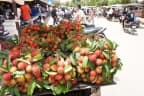
Nephelium lappaceum
Nephelium lappaceum
Safety & Hazards
The fruit wall contains a toxic saponin; cases of poisoning are known[1].
Cultivation Details
Rambutan grows best in the lowland humid tropics at an elevation below 600 metres, though it can also be grown non-commercially up to 1,950 metres[1]. It grows best in areas where annual daytime temperatures are within the range 21 - 35°c, but can tolerate 10 - 42°c[2]. When dormant, a mature plant mat survive temperatures down to about -1°c, but young growth does not tolerate any frost and will be severely damaged at 4°c[2]. Temperatures down to about 5 - 6°c will cause defoliation[2]. It prefers a mean annual rainfall in the range 2,000 - 3,000mm, but tolerates 1,400 - 4,000mm[2]. It prefers climates with all-year rain, but can tolerate up to 2 - 3 dry months[2]. Prefers a sunny position, though young trees appreciate the shelter and dappled shade of trees growing overhead[3, 2]. Prefers a clay loam soil, though it can be grown in a wide range of soil types, even ones with poor drainage, so long as they are not water-logged[1]. Requires a moist fertile acid soil rich in organic matter[4, 3]. Requires shelter from drying winds[1]. Prefers a pH in the range 5 - 6.5, tolerating 4.5 - 7.5[1, 2]. Seedling trees take 6 - 8 years to produce their first crop, whilst grafted trees can fruit in their second year[4]. Fruit yields increase for the next 8 - 10 years; the tree has an economic life of about 15 - 20 or even 30 years, whilst it might live for up to 60 years[2]. Trees usually fruit twice a year, yielding 1,000 - 1,500 fruits per tree per year at age 5 - 7 years and 5,000 - 6,000 fruits per tree for older trees[2]. Very good trees may yield up to 170 kilos per tree and yields per hectare may be from 2 - 20 tonnes[2]. The fruit travels well if packed properly, but shelf life is only a few days, mainly because the fruit loses weight rapidly and appendages and skin turn black. Keeping the fruits moist and shaded prolongs this period slightly[5]. There are many named varieties[6]. Trees are usually dioecious[3], but most commercial cultivars are females that also produce a few male flowers (up to 0.5%) and, with adequate bees and other pollinators present, these are sufficient for fertilization to occur[1, 5].
Propagation
Seed - it has a very short viability and so needs to be sown as soon as it is extracted from the fruit[1]. Wash the seed first to remove traces of the fruit[1]. Sow the seed in containers or in a nursery seedbed in light shade - germination should take place in 7 - 20 days[5]. Properly cared for, the seedlings grow rapidly[4]. They quickly produce a large root system and so need to be planted out into their permanent positions when still young[4]. Layering. Grafting. Cite as: Tropical Plants Database, Ken Fern. tropical.theferns.info. 2026-02-20. <tropical.theferns.info/viewtropical.php?id=Nephelium+lappaceum>
Pollinators
Bees, Insects
References
- [1]World Agroforesty Centre — http://www.worldagroforestry.org/ ↩︎An excellent online database of a huge range of trees giving very good information on each plant - its uses, ecology, identity, propagation, pests etc.
- [2]Ecocrop — http://ecocrop.fao.org/ecocrop/srv/en/home ↩︎Basic information on a wide range of useful plants, plus details of environmental needs where available.
- [3]Tropical and Subtropical Trees - A Worldwide Encyclopaedic Guide. — Barwick. M. · Thames & Hudson, London · 2004 · ISBN 0-500-51181-0 ↩︎A superb book, very concise and well written, giving a wealth of information on 400 or more species including descriptions, habitat, cultivation details and plant uses. A wealth of colour photographs bring each plant vividly to life.
- [4]Tropical Food Gardens — Norrington. L. · Bloomings Books (Melbourne) · 2001 · ISBN 1-876473-41-x ↩︎Excellent little book giving some basic information on a range of plants.
- [5]Plant Resources of Southeast Asia — http://proseanet.org/ ↩︎Lots of information on the uses of the plants of SE Asia.
- [6]Cornucopia II — Facciola. S. · Kampong Publications, California. · 1998 · ISBN 0-9628087-2-5 ↩︎The second edition of an excellent guide to the edible uses of plants, though it does not give any details of cultivation etc.
- [7]Digital Compendium of Forestry Species of Cambodia — www.digitalspecies.blogspot.com; Phnom Penh · 2008 · http://www.digitalspecies.blogspot.com ↩︎A very detailed booklet, produced in PDF format on the internet, giving information on around 100 species of trees.
- [8]Brazilian Fruits and Cultivated Exotics — Lorenzi. H.; Bacher. L.; Lacerda. M.; Sartori. S. · Instituto Plantarum De Estudos Da Flora LTDA; Brazil. · 2000 · ISBN 85-867174-24-0 ↩︎A superb book, giving information on several hundred fruit species. Each entry has a brief description of the plant and its uses, accompanied by one to many excellent quality photographs of the fruits.
- [9]Flora Malesiana Series 1 — Various · Nationaal Herbarium Nederiand, Universiteit Leiden branch · http://www.archive.org ↩︎A massive treatment of the plants of the Malaysian Archipelago. Much of it has been made available to download from the Internet
- [10]IUCN Red List of Threatened Species — http://www.iucnredlist.org/ ↩︎A list of plants under threat and facing possible extinction, usually with brief details of the threats and information on habitat.
- [11]Plants of Southeast Asia — http://www.asianplant.net/ ↩︎Excellent site with brief information on the plant, its range, habitat and uses, plus phots of specimens, close-ops of flowers and leaves etc,
- [12]Dictionary of Economic Plants. — Uphof. J. C. Th. · Weinheim · 1959 · ISBN - ↩︎An excellent and very comprehensive guide but it only gives very short descriptions of the uses without any details of how to utilize the plants. Not for the casual reader.
- [13]Desert Tropicals — http://www.desert-tropicals.com/ ↩︎The main focus of the site is succulent plants, but it also contains information on a wide range of other species. Usually at least one good photograph, plus basic information about the plant and its cultivation.
- [14]Perennial Edible Fruits of the Tropics : an Inventory — Martin, F. W.; Campbell, C. W.; Rubertbe, R. M. · U.S. Dept. of Agriculture, Agricultural Research Service · 1987 ↩︎A booklet giving terse details of almost 300 species of edible fruits, plus regional lists of Botanical and Common names for over 2,500 less well-known edible fruits of the tropics.