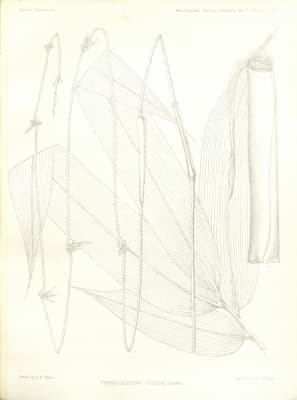
Neohouzeaua helferi
Neohouzeaua helferi
Safety & Hazards
None known
Cultivation Details
Bamboos have an interesting method of growth. Each plant produces a number of new stems annually - these stems grow to their maximum height in their first year of growth, subsequent growth in the stem being limited to the production of new side branches and leaves. In the case of some mature tropical species the new stem could be as much as 30 metres tall, with daily increases in height of 30cm or more during their peak growth time. This makes them some of the fastest-growing species in the world[PFAF]. Like many species of bamboo, this species grows for many years without flowering and then most, if not all plants in the species come into flowering at the same time. The flowering can last for more than a year, the plants usually exhausting themselves in the process and then dying[1, PFAF]. We have no more information for this species, but at least some bamboos can recover after flowering, though it can take several years, and it has been said that the application of chemical fertilizers at this time will only serve to ensure the plant dies[PFAF].
Propagation
Seed - Cite as: Tropical Plants Database, Ken Fern. tropical.theferns.info. 2026-02-20. <tropical.theferns.info/viewtropical.php?id=Neohouzeaua+helferi>
Pollinators
Data unavailable
References
- [1]Bamboos of India: A Compendium — Seethalakshmi K.K., Muktesh Kumar M.S. · Brill. · 2002 · http://www.inbar.int/publication/txt/tr17/default.htm · ISBN 8186247254 ↩︎A very good book giving botanical descriptions of the plants with brief notes on subjects such as uses, habitat and range. It is also available to view on the Internet.
- [2]Annals of the Royal Botanic Garden, Calcutta. Vol. 7 — Gamble J.S. · Bengal Secretariat Press; Calcutta. · 1896 · http://www.biodiversitylibrary.org ↩︎A very comprehensive listing of the bamboos of India, as they were known at the end of the 19th Century. Includes some information on plant uses. It can be downloaded from the Internet.
- [PFAF]Plants for a Future — pfaf.org ↩︎