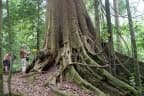
Neobalanocarpus heimii
Neobalanocarpus heimii
Safety & Hazards
None known
Cultivation Details
A plant of the lowland, tropical rainforest, found naturally at elevations from sea level to 1,000 metres[1]. It is found in areas where the mean annual temperature is in the range 24 - 27°c and the mean annual rainfall is 2,000 - 4,000 mm[1]. Grows well on a wide range of soils from sandy granitic soils, red clay over shale and well-drained dark basic volcanic soils[303. Young plants need shade, and can survive in dense shade, but older plants need a sunny position[1, 2]. When very young, the seedlings are sensitive to drought and overexposure to light[2]. Growth is comparatively slow. It is estimated that chengal will attain a diameter of 64 cm in 75 years under optimal conditions[2]. A tree planted in Kepong (Peninsular Malaysia) had a diameter of 48 cm after 40 years[2]. Chengal populations flower sporadically. Usually years with heavy flowering and fruiting occur at intervals of several years[2]. Flowering appears to take place over about 3 weeks and, as in most Dipterocarpaceae, the flowers are fragrant[2]. Pollination is by insects, most particularly honey bees[2]. The only method of dispersal of the heavy, wingless seeds of chengal might be by rolling down hill slopes or by means of animals[2]. Natural regeneration beneath parent trees is rarely abundant in virgin rain forest except on ridges in hill forest. The few seedlings usually encountered beneath a parent tree are capable of surviving for very long periods under dense shade, but light is required for further development[2]. Planting has been attempted in Peninsular Malaysia with indifferent results[2]. Insects attacked the seedlings badly[2]. Planting in open, unshaded conditions, in association with rubber, has failed[2]. Planting in secondary forest was carried out successfully[2]. Planted trees have been known to set fruit as early as the age of ten years[1].
Propagation
Seed - it only has a short period of viability and so should be sown as soon as possible. Sown in shaded conditions, germination is usually rapid, almost without any dormancy[2, 3]. Young trees need to be grown in some shade, but this needs to be reduced as they grow larger[3]. The fruits are best stored at about 14 °C. After storing the fruits at this temperature for 50 days with a loss of 18.7% of the original moisture content and application of a fungicide, they showed no damage. Further reducing of the moisture content to just over half of that of fresh fruits did not kill them either[2]. Cite as: Tropical Plants Database, Ken Fern. tropical.theferns.info. 2026-02-20. <tropical.theferns.info/viewtropical.php?id=Neobalanocarpus+heimii>
Pollinators
Bees, Insects
References
- [1]World Agroforesty Centre — http://www.worldagroforestry.org/ ↩︎An excellent online database of a huge range of trees giving very good information on each plant - its uses, ecology, identity, propagation, pests etc.
- [2]Plant Resources of Southeast Asia — http://proseanet.org/ ↩︎Lots of information on the uses of the plants of SE Asia.
- [3]Seed Leaflets — Various · Forest & Landscape. Denmark · http://en.sl.life.ku.dk/Publikationer/Udgivelser/PopulaerPublikationer.aspx?katid={D28373CC-6EF3-4EF8-B097-6D83FABF209E}&serieid={9F1C3DB1-6E7B-4CF1-AF53-F480B0CB40EF}&sort=title ↩︎A series of leaflets, jointly produced by the University of Copenhagen and the Royal Botanic Gardens at Kew, focussing on seed information for a number species, but also giving a lot of other information about each plant.
- [4]Flora Zambesiaca — http://apps.kew.org/efloras/fz/intro.html ↩︎An excellent online flora of plants from the Zambezi River basin. It lists a number of the plant uses as well as the habitats and botanical descriptions of the plants.
- [5]Gums, Resins and Latexes of Plant Origins. — Coppen J.J.W. · FAO, United Nations; Rome · 1995 · http://www.fao.org/docrep/ · ISBN 92-5-103757-4 ↩︎A handbook published by the Food and Agriculture Organisation of the United Nations, it provides good basic information on the sources and uses of the various gums, resins and latexes. It can be downloaded from the Internet.
- [6]Dictionary of Economic Plants. — Uphof. J. C. Th. · Weinheim · 1959 · ISBN - ↩︎An excellent and very comprehensive guide but it only gives very short descriptions of the uses without any details of how to utilize the plants. Not for the casual reader.
- [7]Tropix 7 — CIRAD · http://tropix.cirad.fr/en ↩︎An on-line guide to the timbers of 245 species of trees.