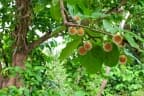
Nauclea orientalis
Nauclea orientalis
Safety & Hazards
None known
Cultivation Details
A plant of the moist tropical lowlands, where it is found at elevations from sea level to 500 metres[1]. It grows best in areas where annual daytime temperatures are within the range 30 - 40°c, but can tolerate 15 - 45°c[2]. It prefers a mean annual rainfall in the range 1,000 - 3,500mm, but tolerates 800 - 3,800mm[2]. Succeeds in most soils, though it prefers alluvial soils along stream banks[1, 2]. Best grown in medium loam, clay loam and always preferring semi-shaded conditions[1]. Prefers a pH in the range 5.5 - 6.5, tolerating 5 - 7.5[2]. Plants can tolerate seasonal inundation of the soil[2].
Propagation
Seed - propagation is commonly done by direct seeding and results are best in summer[1]. Cite as: Tropical Plants Database, Ken Fern. tropical.theferns.info. 2026-02-20. <tropical.theferns.info/viewtropical.php?id=Nauclea+orientalis>
Pollinators
Data unavailable
References
- [1]World Agroforesty Centre — http://www.worldagroforestry.org/ ↩︎An excellent online database of a huge range of trees giving very good information on each plant - its uses, ecology, identity, propagation, pests etc.
- [2]Ecocrop — http://ecocrop.fao.org/ecocrop/srv/en/home ↩︎Basic information on a wide range of useful plants, plus details of environmental needs where available.
- [3]Guide to the Trees of Papua New Guinea — Conn. B.J. & Damas. K.Q. · http://www.pngplants.org/PNGtrees/ ↩︎An Internet site giving good descriptions of the trees of Papua New Guinea.
- [4]Cornucopia II — Facciola. S. · Kampong Publications, California. · 1998 · ISBN 0-9628087-2-5 ↩︎The second edition of an excellent guide to the edible uses of plants, though it does not give any details of cultivation etc.
- [5]Philippine Medicinal Plants — http://www.stuartxchange.org/CompleteList.html ↩︎A lovely site, giving brief details on the medicinal uses of several hundred (over 400 at the last count) plants in the Philippines, plus a picture of each plant.