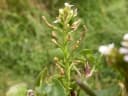
Nasturtium officinale
Nasturtium officinale
Safety & Hazards
Whilst the plant is very wholesome and nutritious, some care should be taken if harvesting it from the wild. Any plants growing in water that drains from fields where animals, particularly sheep, graze should not be used raw. This is due to the risk of it being infested with the liver fluke parasite[1, 2]. Cooking the leaves, however, will destroy any parasites and render the plant perfectly safe to eat[2].
Cultivation Details
Watercress is a plant of the temperate zone, but it can be cultivated in the tropics at elevations between 1,000 - 3,000 metres. It grows best in areas where annual daytime temperatures are within the range 12 - 17°c, but can tolerate 6 - 32°c[3]. When dormant, the plant can survive temperatures down to about -15°c[3]. It prefers a mean annual rainfall in the range 1,000 - 2,300mm, but tolerates 300 - 4,200mm[3]. Watercress is easily grown when given the correct conditions of full sun in slowly flowing clean water, preferably coming from chalky or limestone soils[4]. It prefers to grow in water about 5cm deep[5] with an optimum pH 7.2[6]. Plants can be grown in wet soil if the position is somewhat shaded and protection is given in winter, though the flavour may be hotter[7, 5]. Prefers a pH in the range 6.5 - 7.5, tolerating 4.5 - 8.3[3]. The plant has become a serious river-weed in New Zealand[3]. A first harvest may be taken 30 - 45 days after planting out, and it may thereafter be harvested every 40 - 80 days[3]. Yields can be as high as 50 tonnes per hectare[3]. Watercress is often cultivated for its edible leaves, there are some named varieties[8, 9]. The plant is very sensitive to pollution so a clean source of water is required[6]. Plants will often continue to grow all through mild winters. A fast-growing plant, the stems trail along the ground or float in water and produce new roots at the leaf nodes, thus making the plant very easy to propagate vegetatively[10]. Unfortunately, virus diseases have become more common in cultivated plants and so most propagation is carried out by seed[4]. This is a diploid species. It has hybridised naturally in the wild with the triploid species N. Microphyllum to produce the sterile hybrid N. X sterilis which is also commonly cultivated as a salad crop[4]. The flowers are a rich source of pollen and so are very attractive to bees[11].
Propagation
Seed - sow spring in a pot emmersed to half its depth in water. Germination should take place within a couple of weeks. Prick out seedlings into individual pots whilst they are still small and increase the depth of water gradually until they are submerged. Plant out into a pond in the summer. Cuttings can be taken at any time in the growing season. Virtually any part of the plant, including a single leaf, will form roots if detached from the parent plant[12]. Just put it in a container of water until the roots are well formed and then plant out in shallow water. Cite as: Temperate Plants Database, Ken Fern. temperate.theferns.info. 2026-02-21. <temperate.theferns.info/plant/Nasturtium+officinale>
Pollinators
Bees, Flies, Self
References
- [1]Food for Free. — Mabey. R. · Collins · 1974 · ISBN 0-00-219060-5 ↩︎Edible wild plants found in Britain. Fairly comprehensive, very few pictures and rather optimistic on the desirability of some of the plants.
- [2]Herbs — Phillips. R. & Foy. N. · Pan Books Ltd. London. · 1990 · ISBN 0-330-30725-8 ↩︎Deals with all types of herbs including medicinal, culinary, scented and dye plants. Excellent photographs with quite good information on each plant.
- [3]Ecocrop — http://ecocrop.fao.org/ecocrop/srv/en/home ↩︎Basic information on a wide range of useful plants, plus details of environmental needs where available.
- [4]Vegetables — Phillips. R. & Rix. M. · Macmillan Reference Books, London. · 1995 · ISBN 0 333 62640 0 ↩︎Excellent and easily read book with good information and an excellent collection of photos of vegetables from around the world, including many unusual species.
- [5]The Gardener's Assistant. — Thompson. B. · Blackie and Son. · 1878 · ISBN - ↩︎Excellent general but extensive guide to gardening practices in the 19th century. A very good section on fruits and vegetables with many little known species.
- [6]The New RHS Dictionary of Gardening. 1992. — Huxley. A. · MacMillan Press · 1992 · ISBN 0-333-47494-5 ↩︎Excellent and very comprehensive, though it contains a number of silly mistakes. Readable yet also very detailed.
- [7]The Vegetable Garden. — Vilmorin. A. · Ten Speed Press · ISBN 0-89815-041-8 ↩︎A reprint of a nineteenth century classic, giving details of vegetable varieties. Not really that informative though.
- [8]New Vegetable Growers Handbook. — Simons. · Penguin · 1977 · ISBN 0-14-046-050-0 ↩︎A good guide to growing vegetables in temperate areas, not entirely organic.
- [9]Cornucopia - A Source Book of Edible Plants. — Facciola. S. · Kampong Publications · 1990 · ISBN 0-9628087-0-9 ↩︎Excellent. Contains a very wide range of conventional and unconventional food plants (including tropical) and where they can be obtained (mainly N. American nurseries but also research institutes and a lot of other nurseries from around the world.
- [10]Encyclopaedia of Herbs and their Uses. — Bown. D. · Dorling Kindersley, London. · 1995 · ISBN 0-7513-020-31 ↩︎A very well presented and informative book on herbs from around the globe. Plenty in it for both the casual reader and the serious student. Just one main quibble is the silly way of having two separate entries for each plant.
- [11]Encyclopaedia of Medicinal Plants. — Chiej. R. · MacDonald · 1984 · ISBN 0-356-10541-5 ↩︎Covers plants growing in Europe. Also gives other interesting information on the plants. Good photographs.
- [12]Complete Guide to Water Plants. — Muhlberg. H. · E. P. Publishing Ltd. · 1982 · ISBN 0-7158-0789-7 ↩︎Deals with a wide range of plants for temperate areas (and indoor aquaria) with quite a lot of information on cultivation techniques.
- [13]IUCN Red List of Threatened Species — http://www.iucnredlist.org/ ↩︎A list of plants under threat and facing possible extinction, usually with brief details of the threats and information on habitat.
- [14]Flora of the British Isles. — Clapham, Tutin and Warburg. · Cambridge University Press · 1962 · ISBN - ↩︎A very comprehensive flora, the standard reference book but it has no pictures.
- [15]Salads all the Year Round. — Larkcom. J. · Hamlyn · 1980 ↩︎A good and comprehensive guide to temperate salad plants, with full organic details of cultivation.
- [16]Sturtevant's Edible Plants of the World. — Hedrick. U. P. · Dover Publications · 1972 · ISBN 0-486-20459-6 ↩︎Lots of entries, quite a lot of information in most entries and references.
- [17]Edible and Medicinal Plants. — Launert. E. · Hamlyn · 1981 · ISBN 0-600-37216-2 ↩︎Covers plants in Europe. a drawing of each plant, quite a bit of interesting information.
- [18]Medicinal Plants of China — Duke. J. A. and Ayensu. E. S. · Reference Publications, Inc. · 1985 · ISBN 0-917256-20-4 ↩︎Details of over 1,200 medicinal plants of China and brief details of their uses. Often includes an analysis, or at least a list of constituents. Heavy going if you are not into the subject.
- [19]Dictionary of Economic Plants. — Uphof. J. C. Th. · Weinheim · 1959 · ISBN - ↩︎An excellent and very comprehensive guide but it only gives very short descriptions of the uses without any details of how to utilize the plants. Not for the casual reader.
- [20]The Encyclopedia of Medicinal Plants — Chevallier. A. · Dorling Kindersley. London · 1996 · ISBN 9-780751-303148 ↩︎An excellent guide to over 500 of the more well known medicinal herbs from around the world.
- [21]A Modern Herbal. — Grieve. · Penguin · 1984 · ISBN 0-14-046-440-9 ↩︎Not so modern (1930's?) but lots of information, mainly temperate plants.
- [22]The Herb Book. — Lust. J. · Bantam books · 1983 · ISBN 0-553-23827-2 ↩︎Lots of information tightly crammed into a fairly small book.
- [23]A Field Guide to Medicinal Plants. Eastern and Central N. America. — Foster. S. & Duke. J. A. · Houghton Mifflin Co. · 1990 · ISBN 0395467225 ↩︎A concise book dealing with almost 500 species. A line drawing of each plant is included plus colour photographs of about 100 species. Very good as a field guide, it only gives brief details about the plants medicinal properties.
- [PFAF]Plants for a Future — pfaf.org ↩︎