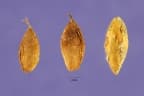
Najas marina
Najas marina
Safety & Hazards
None known
Cultivation Details
Najas marina is a widespread plant growing from the tropical to the temperate zones. A submerged water plant, succeeding in shallow fresh or brackish water[1]. The plant is often found in shallow water in the wild, but can range up to a depth of 6 metres, and it will also occur in alkaline or brackish water. It is mainly found in waters of high temperature, pH, sulphates and high electrolyte concentrations (or in saline sites) on sand, silt, clay with shells and thick organic matter[2]. The plant has brittle stems that break easily, but can then produce roots and develop into a new plant[3]. It has spread to most areas of the world, where it forms dense mats that choke out other species. It is one of the few species of aquatic weeds capable of colonizing brackish waters (between fresh and salt water)[3]. This is one of the few genera of plants where fertilization takes place under the surface of the water[4]. Dioecious, male and female plants must be grown if seed is required[4].
Propagation
Seed - we have no information on this species but suggest sowing the seed in situ as soon as it is ripe if this is possible. Otherwise store the seed in water in a cool place and sow it in situ in the spring. Division in the growing season[1]. Cite as: Temperate Plants Database, Ken Fern. temperate.theferns.info. 2026-02-21. <temperate.theferns.info/plant/Najas+marina>
Pollinators
Water
References
- [1]The New RHS Dictionary of Gardening. 1992. — Huxley. A. · MacMillan Press · 1992 · ISBN 0-333-47494-5 ↩︎Excellent and very comprehensive, though it contains a number of silly mistakes. Readable yet also very detailed.
- [2]IUCN Red List of Threatened Species — http://www.iucnredlist.org/ ↩︎A list of plants under threat and facing possible extinction, usually with brief details of the threats and information on habitat.
- [3]Pacific Island Ecosystems at Risk — http://www.hear.org/pier/scientificnames/index.html ↩︎A very good website detailing weed species that have been introduced into the Pacific Islands.
- [4]Illustrated Flora of North Central Texas — Diggs, Jnr. G.M.; Lipscomb. B. L. & O'Kennon. R. J · Botanical Research Institute, Texas. · 1999 · http://artemis.austincollege.edu/acad/bio/gdiggs/NCTXpdf.htm · ISBN 1-889878-01-4 ↩︎An excellent flora, which is also available on-line.
- [5]Flora Europaea — ? · Cambridge University Press · 1964 · ISBN - ↩︎An immense work in 6 volumes (including the index). The standard reference flora for Europe, it is very terse though and with very little extra information. Not for the casual reader.
- [6]Flora of China — Missouri Botanical Garden Press; St. Louis. · 1994 · http://flora.huh.harvard.edu/china/ ↩︎An excellent, comprehensive resource in 25 volumes. In addition to the botanical information the flora also gives basic information on habitat and some uses. An on-line version is also available.
- [7]Flora of N. America — http://flora.huh.harvard.edu/fna/ ↩︎An on-line version of the flora with an excellent description of the plant including a brief mention of plant uses.
- [8]Dictionary of Economic Plants. — Uphof. J. C. Th. · Weinheim · 1959 · ISBN - ↩︎An excellent and very comprehensive guide but it only gives very short descriptions of the uses without any details of how to utilize the plants. Not for the casual reader.
- [9]A Dictionary of Plants Used by Man. — Usher. G. · Constable · 1974 · ISBN 0094579202 ↩︎Forget the sexist title, this is one of the best books on the subject. Lists a very extensive range of useful plants from around the world with very brief details of the uses. Not for the casual reader.
- [10]Tanaka's Cyclopedia of Edible Plants of the World. — Tanaka. T. & Nakao S. · Keigaku Publishing; Tokyo · 1976 · ISBN - ↩︎The most comprehensive list of edible plants I've come across. Only the briefest entry for each species, though, and some of the entries are more than a little dubious. Not for the casual reader.