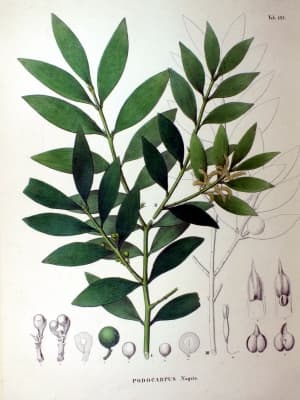
Nageia nagi
Nageia nagi
Safety & Hazards
None known
Cultivation Details
Nageia nagi is an evergreen tree growing mainly in subtropical climates, but extending into the tropics in southern China and also able to be grown in warm temperate zones. The species is hardy to about -20°c, but plants require a 4 month hot humid summer in order to fully mature the new growth and to be able to withstand such cold conditions[1]. It is best grown in a warm continental climate[1]. Based on data from 19 collection localities, it grows at elevations of 201 ±198 m. Within its range, the mean annual temperature is 16.7°c, with an average minimum in the coldest month of 4.3°c, and a mean annual precipitation of 1973mm. It is hardy to Zone 8 (cold hardiness limit between -12.1°c and -6.7°c)[2]. It is a shade-tolerant tree when young, but when mature, may become a canopy dominant. It is suitable for growing on feralitic, deep and fertile, loamy-sandy soils[2]. A dioecious species, both male and female forms must be grown if seed is required[2].
Propagation
Seed - can be sown at any time of the year in a sandy soil in a warm greenhouse, though it is probably best sown as soon as it is ripe[3]. When they are large enough to handle, prick the seedlings out into individual pots and grow them on in the greenhouse for at least their first winter. Plant them out into their permanent positions in late spring or early summer, after the last expected frosts. Cuttings of half-ripe terminal shoots, 5 - 10cm long, mid summer in a frame[4]. Cite as: Temperate Plants Database, Ken Fern. temperate.theferns.info. 2026-02-21. <temperate.theferns.info/plant/Nageia+nagi>
Pollinators
Wind
References
- [1]The New RHS Dictionary of Gardening. 1992. — Huxley. A. · MacMillan Press · 1992 · ISBN 0-333-47494-5 ↩︎Excellent and very comprehensive, though it contains a number of silly mistakes. Readable yet also very detailed.
- [2]The Gymnosperm Database — http://www.conifers.org/index.htm ↩︎A vast amount of information on conifers and families of gymnosperms.
- [3]RHS Dictionary of Plants plus Supplement. 1956 — F. Chittendon. · Oxford University Press · 1951 · ISBN - ↩︎Comprehensive listing of species and how to grow them. Somewhat outdated, it has been replaced in 1992 by a new dictionary (see [ 200 ]).
- [4]Propagation of Trees, Shrubs and Conifers. — Sheat. W. G. · MacMillan and Co · 1948 · ISBN - ↩︎A bit dated but a good book on propagation techniques with specific details for a wide range of plants.
- [5]Flora of China — Missouri Botanical Garden Press; St. Louis. · 1994 · http://flora.huh.harvard.edu/china/ ↩︎An excellent, comprehensive resource in 25 volumes. In addition to the botanical information the flora also gives basic information on habitat and some uses. An on-line version is also available.
- [6]IUCN Red List of Threatened Species — http://www.iucnredlist.org/ ↩︎A list of plants under threat and facing possible extinction, usually with brief details of the threats and information on habitat.
- [7]Cornucopia - A Source Book of Edible Plants. — Facciola. S. · Kampong Publications · 1990 · ISBN 0-9628087-0-9 ↩︎Excellent. Contains a very wide range of conventional and unconventional food plants (including tropical) and where they can be obtained (mainly N. American nurseries but also research institutes and a lot of other nurseries from around the world.
- [8]A Dictionary of Malaysian Timbers — Wong T.M. · Forest Research Institute Malaysia; Kuala Lumpur · 2002 · http://Elaeocarpaceae · ISBN 983-2181-29-1 ↩︎A fairly comprehensive guide to Malaysian timbers, giving their properties and the main tree species from which they are obtained.