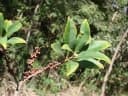
Myrsine coriacea
Myrsine coriacea
Safety & Hazards
None known
Cultivation Details
A plant of the subtropics to the tropics, descending to lower elevations in the subtropics but rarely below 500 metres in the tropics and most commonly at elevations from 1,500 metres to over 3,000 metres. Grows best in a sunny position[1]. Prefers a moist soil[1]. A fast-growing plant, able to reach a height of 3 - 4 metres within 2 years from seed[1]. Plants will often flower and produce fruit all year round[2]. Usually a dioecious species, though bisexual flowers are sometimes found. Generally, both male and female forms need to be grown if fruit and seed are required[2].
Propagation
Seed - best sown as soon as it is ripe in a partially shaded position in a nursery seedbed. A low germination rate can be expected, with the seed sprouting within 30 - 60 days[1]. When the seedlings are 4 - 5cm tall, pot them up into individual containers and they should be ready to plant out 5 - 6 months later[1]. The seed has a short viability of less than 3 months in storage[1]. Cite as: Tropical Plants Database, Ken Fern. tropical.theferns.info. 2026-02-20. <tropical.theferns.info/viewtropical.php?id=Myrsine+coriacea>
Pollinators
Data unavailable
References
- [1]Brazilian Trees. Volume 1. 4th Edition. — Lorenzi. H. · Instituto Plantarum De Estudos Da Flora; Brazil. · 2002 · ISBN 85-86714-17-8 ↩︎Information on 350 species of Brazilian trees. Stunning photographs of each species, brief details on the plant, its uses and how to grow it from seed. A superb work, with the minor irritation that the translation from Portuguese is not of the best.
- [2]Common Trees of Puerto Rico and the Virgin Islands — Little E.L.; Wadsworth F.H. · USDA, Forest Service; Washington. · 1964 ↩︎Contains detailed information, and usually an illustration, on 250 tree species, including both native and exotic species.