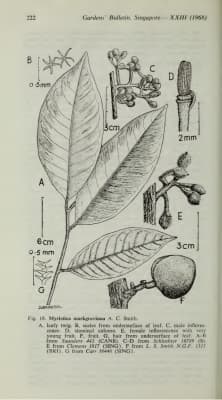
Myristica markgraviana
Myristica markgraviana
Safety & Hazards
None known
Cultivation Details
Members of this genus are mainly understorey and canopy trees of primary woodland. They need the shade of woodland, especially when young, though can often tolerate more open positions as they grow larger. They usually succeed on a range of soil types. Most species have a superficial root system and are best grown in positions sheltered from strong winds[1]. Flowers are produced at the end of the branches[1]. A dioecious species, both male and female forms need to be grown if seed is required.
Propagation
Seed - dries out easily, loses its viability rapidly, and cannot be stored. It is best sown in a shaded position in a nursery seedbed - germination is usually fairly quick with the seed of most species sprouting within 2 - 17 weeks[1, 2]. Grow the young plants on in a shady position, planting them out in their permanent positions when large enough. Cite as: Tropical Plants Database, Ken Fern. tropical.theferns.info. 2026-02-20. <tropical.theferns.info/viewtropical.php?id=Myristica+markgraviana>
Pollinators
Bees, Insects
References
- [1]Plant Resources of Southeast Asia — http://proseanet.org/ ↩︎Lots of information on the uses of the plants of SE Asia.
- [2]The Gardens' Bulletin Vol. 23 — Botanic Gardens Park and Recreation Department; Singapore · 1968 · http://www.biodiversitylibrary.org ↩︎A botanical journal, this one contains a revision of the genus Myristica.
- [3]Guide to the Trees of Papua New Guinea — Conn. B.J. & Damas. K.Q. · http://www.pngplants.org/PNGtrees/ ↩︎An Internet site giving good descriptions of the trees of Papua New Guinea.
- [4]Flora Malesiana Series 1 — Various · Nationaal Herbarium Nederiand, Universiteit Leiden branch · http://www.archive.org ↩︎A massive treatment of the plants of the Malaysian Archipelago. Much of it has been made available to download from the Internet
- [5]Handbooks of the Flora of Papua New Guinea — Womersley. J.S. (Editor) · Melbourne University Press · 1995 · ISBN 0 522 84095 7 ↩︎Only a part of the flora, but an excellent publication in 3 volumes. It can be downloaded from the internet.
- [6]Tropical Timbers of the World. Ag. Handbook No. 607. — Chudnoff. Martin. · USDA Forest Service. Wisconsin. · 1984 ↩︎Terse details on the properties of the wood of almost 400 species of trees from the Tropics.
- [7]Tree Flora of Sabah and Sarawak Vols 1 - 6 — Soepadmo E.; Saw L.G.; Chung R.C.K. (Editors) · Forest Research Institute Malaysia; Kuala Lumpur. · 2002 · ISBN 983-2181-27-5 ↩︎A flora of the woody plants of Sabah and Sarawak on the island of Borneo, often giving details of plant uses.