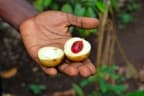
Myristica fragrans
Myristica fragrans
Safety & Hazards
None known
Cultivation Details
The plant is most suited to growing in the coastal regions of lowland humid tropical areas[1], though it can also succeed at elevations up to 500 metres. It grows best in areas where annual daytime temperatures are within the range 22 - 34°c, but can tolerate 12 - 38°c[2]. Plants are also very susceptible to frost damage[3]. When dormant, the plant can survive temperatures down to about 5°c[2]. It prefers a mean annual rainfall in the range 1,500 - 3,500mm, but tolerates 1,200 - 4,000mm[2]. It prefers growing in areas without a pronounced dry season[4]. Succeeds in full sun and in dappled shade[2]. The tree can grow on any kind of soil provided there is sufficient water, but it must be well-drained[4]. Preferred soils are those of volcanic origin and soils with a high content of organic matter with a pH in the range 6.5 - 7.5[4]. Prefers a pH in the range 6 - 7, tolerating 5.5 - 7.5[2]. The tree only has a superficial root system and so needs to be grown in a position sheltered from strong winds[4]. Seedling trees can commence fruiting when about 8 - 10 years old, whilst grafts can fruit when 4 - 5 years old[3]. One tree can produce 1,000 - 5,000 fruits per year[2]. Yields of nutmeg vary between 500 - 1,200 kilos per hectare[2]. Peak production is attained after 15 - 20 years, and the trees have an economic life of 30 - 40 years, or even 60 - 70 years[2]. Flowering is probably induced by short dry periods[4]. Fruiting is more seasonal in regions with a pronounced dry season[4]. Nutmeg is not strictly dioecious[4]. Male trees show different degrees of femaleness, varying from no fruits at all to as many fruits as a good female tree[4]. A ratio of about 10% male trees should be distributed regularly through the plantation in order to secure a good level of pollination[4].
Propagation
Seed - best sown when fresh[1]. Germination usually takes place in 5 - 6 weeks[1]. Seed in the shell takes some 4 - 6 weeks to germinate; without the shell it may germinate in half that time[4]. The seed can take up to 30 months to germinate[5]. Seedlings need to be transplanted carefully in order to avoid damage to the delicate taproot[1]. Nutmeg is usually propagated by seed, resulting in equal numbers of male and female trees[4]. The seedlings reveal their sex at first flowering, which usually occurs some 6 years after planting[4]. Therefore 2 - 3 seedlings are usually planted on the same spot. Male trees are then cut out and excess female trees may be transplanted to positions where there are no female trees[4]. Cuttings of half-ripe wood. Air layering. After about 3 - 5 months, the rooted watershoot is cut off and planted in a nursery. After a period of growth it is hardened off and planted in the field. This method succeeds in 60-70% of cases[4]. Grafting of known female forms onto seedlings[1]. Cite as: Tropical Plants Database, Ken Fern. tropical.theferns.info. 2026-02-20. <tropical.theferns.info/viewtropical.php?id=Myristica+fragrans>
Pollinators
Moths, Insects
References
- [1]The New RHS Dictionary of Gardening. 1992. — Huxley. A. · MacMillan Press · 1992 · ISBN 0-333-47494-5 ↩︎Excellent and very comprehensive, though it contains a number of silly mistakes. Readable yet also very detailed.
- [2]Ecocrop — http://ecocrop.fao.org/ecocrop/srv/en/home ↩︎Basic information on a wide range of useful plants, plus details of environmental needs where available.
- [3]Perennial Edible Fruits of the Tropics : an Inventory — Martin, F. W.; Campbell, C. W.; Rubertbe, R. M. · U.S. Dept. of Agriculture, Agricultural Research Service · 1987 ↩︎A booklet giving terse details of almost 300 species of edible fruits, plus regional lists of Botanical and Common names for over 2,500 less well-known edible fruits of the tropics.
- [4]World Agroforesty Centre — http://www.worldagroforestry.org/ ↩︎An excellent online database of a huge range of trees giving very good information on each plant - its uses, ecology, identity, propagation, pests etc.
- [5]Tropical and Subtropical Trees - A Worldwide Encyclopaedic Guide. — Barwick. M. · Thames & Hudson, London · 2004 · ISBN 0-500-51181-0 ↩︎A superb book, very concise and well written, giving a wealth of information on 400 or more species including descriptions, habitat, cultivation details and plant uses. A wealth of colour photographs bring each plant vividly to life.
- [6]Cornucopia II — Facciola. S. · Kampong Publications, California. · 1998 · ISBN 0-9628087-2-5 ↩︎The second edition of an excellent guide to the edible uses of plants, though it does not give any details of cultivation etc.
- [7]Encyclopaedia of Herbs and their Uses. — Bown. D. · Dorling Kindersley, London. · 1995 · ISBN 0-7513-020-31 ↩︎A very well presented and informative book on herbs from around the globe. Plenty in it for both the casual reader and the serious student. Just one main quibble is the silly way of having two separate entries for each plant.
- [8]Plant Resources of Southeast Asia — http://proseanet.org/ ↩︎Lots of information on the uses of the plants of SE Asia.
- [9]Tropical Timbers of the World. Ag. Handbook No. 607. — Chudnoff. Martin. · USDA Forest Service. Wisconsin. · 1984 ↩︎Terse details on the properties of the wood of almost 400 species of trees from the Tropics.
- [10]Tree Flora of Sabah and Sarawak Vols 1 - 6 — Soepadmo E.; Saw L.G.; Chung R.C.K. (Editors) · Forest Research Institute Malaysia; Kuala Lumpur. · 2002 · ISBN 983-2181-27-5 ↩︎A flora of the woody plants of Sabah and Sarawak on the island of Borneo, often giving details of plant uses.