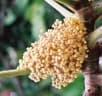
Musanga cecropioides
Musanga cecropioides
Safety & Hazards
None known
Cultivation Details
A tree of the wet, lowland tropics, where it can be found at elevations up to 200 metres[1]. It grows best in areas where the mean maximum and minimum temperatures are within the range 28 - 36°c, though it can tolerate 20 - 40°c[1]. It prefers a mean annual rainfall in the range 3,000 - 4,000mm, tolerating 2,000 - 5,000mm[1]. Requires a sunny position[2]. Prefers a pH in the range 4.5 - 5.5, tolerating 4 - 6.5[1]. Although we have seen no reports of this species becoming invasive, it produces fruits embedded with small seeds. These fruits are much relished by wildlife, which thus spread the seed widely. Within the plants native range it is a vigorous pioneer, rapidly invading cleared land. This habit gives it the potential to escape from cultivation and invade non-native areas if it is cultivated outside is native range[PFAF]. A very fast-growing tree when young, with some plants reaching a height of 5 metres within 12 months[3]. The tree is short-lived, with a life span of around 20 years. It generally dies even before it is overshadowed by taller species[3]. A dioecious species, both male and female forms need to be grown if fruit and seed is required.
Propagation
Seed - Cite as: Tropical Plants Database, Ken Fern. tropical.theferns.info. 2026-02-20. <tropical.theferns.info/viewtropical.php?id=Musanga+cecropioides>
Pollinators
Data unavailable
References
- [1]Ecocrop — http://ecocrop.fao.org/ecocrop/srv/en/home ↩︎Basic information on a wide range of useful plants, plus details of environmental needs where available.
- [2]The Useful Plants of West Tropical Africa. — Burkil. H. M. · Royal Botanic Gardens; Kew. · 1985 - 2004 ↩︎Brief descriptions and details of the uses of over 4,000 plants. A superb, if terse, resource, it is also available electronically on the Web - see http://www.aluka.org/
- [3]World Agroforesty Centre — http://www.worldagroforestry.org/ ↩︎An excellent online database of a huge range of trees giving very good information on each plant - its uses, ecology, identity, propagation, pests etc.
- [4]African Flowering Plants Database — Conservatoire et Jardin Botaniques. · http://www.ville-ge.ch/musinfo/bd/cjb/africa/recherche.php ↩︎Contains information on over 150,000 plant names (including synonyms) giving a description and habitat, plus a distribution map.
- [PFAF]Plants for a Future — pfaf.org ↩︎