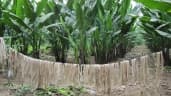
Musa textilis
Musa textilis
Safety & Hazards
None known
Cultivation Details
A plant of the hot, humid tropics adapted to an average relative humidity of about 80%[1]. The present zone of successful cultivation lies within the latitudinal range 15°N and 5°S. In the Philippines it is usually grown in regions below 500 metres in elevations but it can be grown in the tropics at altitudes between sea level and 1100 metres[1]. It grows best in areas where the mean annual temperature falls within the range 20 - 29°c, but can tolerate 16 - 33°c[1]. It prefers a mean annual rainfall in the range 1,800 - 3,000mm, tolerating 700 - 4,400mm[1]. Prefers a sunny position[1]. Plants can succeed in most humus-rich, fertile soils, so long as they are well-drained[1]. Prefers a pH in the range 5.5 - 7, though it can tolerate 4.5 - 8[1]. Prefers a position sheltered from strong winds. A perennial plant, growing for 18 - 36 months years before first harvest and with a economical life of 6 - 15 years[1]. In the Philippines, the annual fibre yield ranges from 0.31 - 1.71 t/ha, while in Ecuador, yields are between 1.5 - 2.5 t/ha[1].
Propagation
Seed - Division of suckers with a portion of the rhizome[2]. Cite as: Tropical Plants Database, Ken Fern. tropical.theferns.info. 2026-02-20. <tropical.theferns.info/viewtropical.php?id=Musa+textilis>
Pollinators
Data unavailable
References
- [1]Ecocrop — http://ecocrop.fao.org/ecocrop/srv/en/home ↩︎Basic information on a wide range of useful plants, plus details of environmental needs where available.
- [2]The New RHS Dictionary of Gardening. 1992. — Huxley. A. · MacMillan Press · 1992 · ISBN 0-333-47494-5 ↩︎Excellent and very comprehensive, though it contains a number of silly mistakes. Readable yet also very detailed.
- [3]Mansfeld's Database of Agricultural and Horticultural Plants — http://mansfeld.ipk-gatersleben.de/pls/htmldb_pgrc/f?p=185:3:4292127278597336 ↩︎Terse details of a huge range of useful plants.
- [4]Dictionary of Economic Plants. — Uphof. J. C. Th. · Weinheim · 1959 · ISBN - ↩︎An excellent and very comprehensive guide but it only gives very short descriptions of the uses without any details of how to utilize the plants. Not for the casual reader.