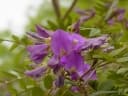
Mundulea sericea
Mundulea sericea
Safety & Hazards
The pounded bark, leaves and sometimes the seeds and roots are used for fish poisoning. Very effective, unlike most other fish poisons which merely stun the fish, this plant usually kills them but also usually leaves them safe to eat[1].
Cultivation Details
Succeeds in full sun or in light shade. Prefers a well-drained, deep sandy or gravelly soil, preferably rich in organic matter[1]. The tree is relatively slow-growing with a growth rate of 50 - 100cm per year, though the growth rate increases as the tree ages[1]. The corky bark of this species helps to give it some protection from bush fires[1]. Plants respond well to coppicing[1]. The root system is not aggressive[1]. This species has a symbiotic relationship with certain soil bacteria; these bacteria form nodules on the roots and fix atmospheric nitrogen. Some of this nitrogen is utilized by the growing plant but some can also be used by other plants growing nearby[2].
Propagation
Seed - it has a hard seedcoat and benefits from scarification before sowing in order to speed up and improve germination. This can usually be done by pouring a small amount of nearly boiling water on the seeds (being careful not to cook them!) and then soaking them for 12 - 24 hours in warm water. By this time they should have imbibed moisture and swollen - if they have not, then carefully make a nick in the seedcoat (being careful not to damage the embryo) and soak for a further 12 hours before sowing. The seeds should germinate in 2 - 6 weeks. When the seedlings reach the two-leaf stage (12 - 16 weeks after sowing), transplant them into nursery bags, pots or individual containers. Use sandy soil (or clay soil with 50% sand mixed in) with some well-rotted compost, taking care not to damage the long taproot. Seedlings and young trees usually transplant well[1]. Cuttings[3]. Cite as: Tropical Plants Database, Ken Fern. tropical.theferns.info. 2026-02-20. <tropical.theferns.info/viewtropical.php?id=Mundulea+sericea>
Pollinators
Bees
References
- [1]PlantZAfrica.com — http://www.plantzafrica.com ↩︎An excellent site giving detailed descriptions and uses of many S. African plants.
- [2]Nodulation Plants in GRIN Taxonomy — United States Department of Agriculture · http://www.ars-grin.gov/~sbmljw/cgi-bin/taxnodul.pl?language=en ↩︎An online database listing plants that have either positive or negative reports on root and stem nodulation with nitrogen-fixing bacteria.
- [3]Plant Resources of Southeast Asia — http://proseanet.org/ ↩︎Lots of information on the uses of the plants of SE Asia.
- [4]African Flowering Plants Database — Conservatoire et Jardin Botaniques. · http://www.ville-ge.ch/musinfo/bd/cjb/africa/recherche.php ↩︎Contains information on over 150,000 plant names (including synonyms) giving a description and habitat, plus a distribution map.
- [5]Flora of Tropical East Africa — Beentje H.J. · Royal Botanic Gardens; Kew. · 2002 · http://plants.jstor.org/search?st=396814 ↩︎Available on-line, a modern flora of East Africa.
- [6]A Manual of Indian Timbers. — Gamble. J. S. · Bishen Singh Mahendra Pal Singh · 1972 · ISBN - ↩︎First written in the 19th century, but still a classic, giving a lot of information on the uses and habitats of Indian trees. Not for the casual reader.