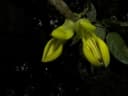
Mucuna sloanei
Mucuna sloanei
Safety & Hazards
Mucuna species often possess irritant hairs on the seedpods and sometimes on the flowers and other parts. These hairs consist of 1-2 small basal cells and a large needle-like top cell. The top cell breaks off easily, piercing the skin and injecting chemical compounds that are present in the hairs. The proteolytic enzyme 'Mucunain' is said to be the active agent[1]. The hairs can contaminate clothes or other objects, and remain active when dried, though they can be destroyed by heat[2, 3, 4]. Intense itching, with reddening of the skin and small papules or urticaria occur a few minutes after contact with the hairy parts of the plant. There is no serious danger, unless the hairs get into the eye, in which case, in extreme situations, they have caused blindness. To remove the hairs from the skin, adhesive tape and washing with water and soap are considered useful. Dermatitis can be treated with corticosteroid ointment. See a doctor immediately if hairs go into the eyes[3].
Cultivation Details
Mucuna species generally grow best in a shady position in a humus-rich, moist but well-drained soil[5]. Cultivation of Mucuna sloanei is done using tall poles, as for climbing types of common bean[2]. There are conflicting reports on whether or not this species has a symbiotic relationship with certain soil bacteria, so it is unclear as to whether it fixes atmospheric nitrogen[6].
Propagation
Seed - Cite as: Tropical Plants Database, Ken Fern. tropical.theferns.info. 2026-02-20. <tropical.theferns.info/viewtropical.php?id=Mucuna+sloanei>
Pollinators
Data unavailable
References
- [1]Notes on Malesian Fabaceae (Leguminosae-Papilionoideae) 16. The genus Mucuna — Wiriadinata H.; Ohashi H.; Adema F. · 2016 · http://dx.doi.org/10.3767/000651916X692799 ↩︎An excellent treatment
- [2]Protabase - Plant Resources of Tropical Africa. — http://www.prota.org ↩︎An excellent on-line database with detailed information on over 3,200 species of useful plants of Africa.
- [3]Contact-Poisonous Plants of the World — Rohde. M. · 2006 · http://mic-ro.com/plants/ ↩︎A document on the internet. Gives brief information on about 35 species of plants that can cause severe problems from a single contact with the skin.
- [4]The Leguminosae; A Source Book of Characteristics, Uses and Nodulation — Allen O.N.; Allen E.K. · University of Wisconsin · 1981 · ISBN 0-333-32221-5 ↩︎An amazing and comprehensive work, giving a brief guide to the many genera of the family Fabaceae and also the principle uses of the genus.
- [5]Encyclopedia of Tropical Plants - Identification and Cultivation of over 3,000 Tropical Plants — Ahmed Fayaz · Firefly Books Ltd.; New Zealand · 2011 · ISBN 978-1-55407-489 ↩︎A good photograph and terse but detailed information for over 3,000 species of tropical plants. An excellent reference.
- [6]Nodulation Plants in GRIN Taxonomy — United States Department of Agriculture · http://www.ars-grin.gov/~sbmljw/cgi-bin/taxnodul.pl?language=en ↩︎An online database listing plants that have either positive or negative reports on root and stem nodulation with nitrogen-fixing bacteria.
- [7]African Flowering Plants Database — Conservatoire et Jardin Botaniques. · http://www.ville-ge.ch/musinfo/bd/cjb/africa/recherche.php ↩︎Contains information on over 150,000 plant names (including synonyms) giving a description and habitat, plus a distribution map.
- [8]Flora of Jamaica — Fawcett. W. & Rendle. A. B. · British Museum · 1910 ↩︎Rather dated, so many name changes. Nevertheless, a very good guide to the plants of the Caribbean. The book is out of copyright and can be legally downloaded from various websites.
- [9]Bulletin of the British Museum (Natural History). Vol. 3 — The British Museum; London. · 1965 · http://www.biodiversitylibrary.org ↩︎A botanical magazine, amongst the various articles is a monograph of the genus Buchenavia. It can be downloaded from the Internet.
- [10]Trees and Shrubs of Mexico — Standley P.C. · Smithsonian Institution; Washington · 1926 ↩︎Although dated, it contains a wealth of information on the trees and shrubs of Mexico, including many of their uses. It can be downloaded from the Internet.
- [11]Medicinal Plants of the Guianas — DeFilipps, R. A.; Maina, S. L.; & Crepin, J. · Smithsonian Museum · http://botany.si.edu/bdg/medicinal/index.html ↩︎A down-loadable PDF document of a book in pre-publication awaiting illustration. An excellent, if rather terse, guide to the traditional medicinal uses of the plants of the region