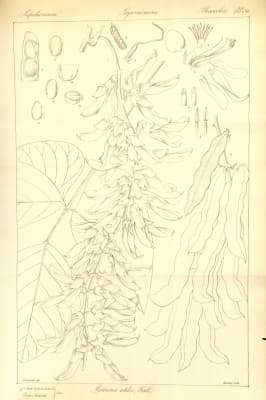
Mucuna pruriens utilis
Mucuna pruriens utilis
Safety & Hazards
The seed contains a range of anti-nutritive substances and can be toxic for human and non-ruminant animal consumption. The most important toxic compounds are the non-protein amino acids L-dopa (content in seeds <2% - >7%) and hallucinogenic tryptamines[1]. Furthermore, trypsin-inhibiting activities have been detected in the seed[1].
Cultivation Details
Velvet bean is native to the hot and humid tropics, where it is found at elevations up to 2,100 metres, though it can also be cultivated in the sub-tropical and warm temperate regions[2]. It grows best in areas where annual daytime temperatures are within the range 20 - 30°c, but can tolerate 10 - 35°c[3]. Young growth can be severely damaged at 5°c[3]. It prefers a mean annual rainfall in the range 1,200 - 1,500mm, but tolerates 1,000 - 3,000mm[3]. Prefers a well-drained, moist, humus-rich soil and a position in full sun or partial shade[4]. The plant has some tolerance to drought but is not tolerant to waterlogging[1]. Prefers a pH in the range 5 - 6.5, tolerating 4 - 7.5[3]. Velvet bean grows very fast and can cover the ground in 2 - 3 months[2]. Distribution of the roots tends to be very shallow and concentrated in the fertile topsoil[2]. Roots form where creeping stems touch the soil[2]. Flowering commences 90 - 145 days after sowing, and pods begin to ripen 2 - 3 months after flowering. The first harvest of dry seed may be expected after 200 - 230 days[2]. On good soils in the southern United States, seed yields of 900 - 1,200 kilos per hectare have been achieved. In Hawaii up to 1,500 kilos have been obtained, whilst in India yields range from 250 - 1,150 kilos[2]. When grown as a cover crop in rubber plantation a fresh organic matter yield of about 2 tonnes per hectare can be obtained in about 6 months[2]. This species has a symbiotic relationship with certain soil bacteria, these bacteria form nodules on the roots and fix atmospheric nitrogen. Some of this nitrogen is utilized by the growing plant but some can also be used by other plants growing nearby[5]. When removing plant remains at the end of the growing season, it is best to only remove the aerial parts of the plant, leaving the roots in the ground to decay and release their nitrogen.
Propagation
Seed - pre-soak dried seed for 24 hours in warm water prior to sowing. Sow in situ - germination takes 4 - 7 days with around 90 - 100% of the seeds sprouting[2]. Cite as: Tropical Plants Database, Ken Fern. tropical.theferns.info. 2026-02-20. <tropical.theferns.info/viewtropical.php?id=Mucuna+pruriens+utilis>
Pollinators
Self
References
- [1]Tropical Forages — http://www.tropicalforages.info/key/Forages/Media/Html/index.htm ↩︎Mainly focussed on forage plants, the site gives a lot of information on the plant, with a good botanical description, details of cultivation, plant uses and a good selection of photographs.
- [2]Plant Resources of Southeast Asia — http://proseanet.org/ ↩︎Lots of information on the uses of the plants of SE Asia.
- [3]Ecocrop — http://ecocrop.fao.org/ecocrop/srv/en/home ↩︎Basic information on a wide range of useful plants, plus details of environmental needs where available.
- [4]Encyclopaedia of Herbs and their Uses. — Bown. D. · Dorling Kindersley, London. · 1995 · ISBN 0-7513-020-31 ↩︎A very well presented and informative book on herbs from around the globe. Plenty in it for both the casual reader and the serious student. Just one main quibble is the silly way of having two separate entries for each plant.
- [5]The New RHS Dictionary of Gardening. 1992. — Huxley. A. · MacMillan Press · 1992 · ISBN 0-333-47494-5 ↩︎Excellent and very comprehensive, though it contains a number of silly mistakes. Readable yet also very detailed.
- [6]Cornucopia II — Facciola. S. · Kampong Publications, California. · 1998 · ISBN 0-9628087-2-5 ↩︎The second edition of an excellent guide to the edible uses of plants, though it does not give any details of cultivation etc.
- [7]Sturtevant's Edible Plants of the World. — Hedrick. U. P. · Dover Publications · 1972 · ISBN 0-486-20459-6 ↩︎Lots of entries, quite a lot of information in most entries and references.