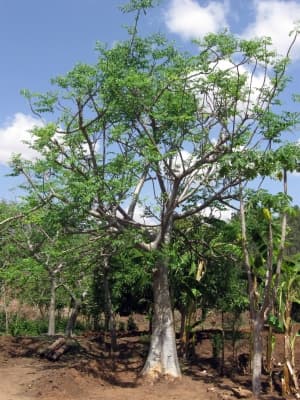
Moringa stenopetala
Moringa stenopetala
Safety & Hazards
The glucosinolates in the leaves were found to cause goitre but to a lesser extent than expected on the basis of their concentration. However, in a diet poor in iodine it may be a contributing factor[1].
Cultivation Details
A plant of the arid to moist tropics, where it can be grown at elevations from 390 - 2,200 metres. It grows best in areas where annual daytime temperatures are within the range 25 - 35°c, but can tolerate 15 - 48°c[2]. Plants can tolerate light frosts, even heavier frosts do not always kill the plant since it is able to resprout from the base[1, 2]. It prefers a mean annual rainfall in the range 500 - 1,500mm, but tolerates 200 - 2,800mm[2]. Grows best in a sunny position, but tolerates light shade[3, 2]. Prefers a well-drained soil with a high groundwater table, but it can also withstand dry conditions well, and consequently it is found in both wetlands and dry areas[1, 3]. Prefers a pH in the range 6 - 8, tolerating 5 - 9[2]. Plants are very drought tolerant, remaining green and continuing to grow even during exceptionally long dry seasons[2]. In experimental plantings in Sudan, plants reached a height of 3 metres within 14 months. The first flowers appeared 30 months after sowing.[1] The first leaves can be harvested after about 3 years[1]. Trees are pruned every 5 years during the rainy season[1]. The leaves are preferably left on the trees during the rainy season when other vegetables are in ample supply[1]. The leaves have a better taste in the dry season than during the rains[1]. Yield estimates are scarce. Annual production can reach 2,000 fruits or 6 kg of seed per tree under ideal conditions[1]. At elevations of over 1,650 m no fruits at all are harvested and leaf production is poor[1]. The taste of the leaves differs between trees and ranges from sweet to bitter[1].
Propagation
Seed - sow in individual pots in a semi-shaded position, placing the seed 1cm deep in a mixture of sand and loam enriched with compost[1]. Do not allow the compost to become dry. Germination rates of fresh seeds approaches 100%, they germinate fastest at 25 - 30°c. Transplanting to permanent positions can be done when the plants are 20cm tall or 6 months old, and with proper water supply (about 25 litres of water every 3 - 4 days) all plants should survive[1]. Seeds of up to 1 year old have a germination rate close to 100%; germination of older seeds is variable and declines as a function of age and storage method[1]. The most common practice in traditional cultivation is to transplant seedlings that have become established under old trees. Before transplanting, branches and roots are cut and the seedlings are left to dry for a week, roots are covered with ash and upper parts with dung[1]. Cuttings can be used, but trees established from cuttings were found to have a poor root system[1]. Cite as: Tropical Plants Database, Ken Fern. tropical.theferns.info. 2026-02-20. <tropical.theferns.info/viewtropical.php?id=Moringa+stenopetala>
Pollinators
Data unavailable
References
- [1]Protabase - Plant Resources of Tropical Africa. — http://www.prota.org ↩︎An excellent on-line database with detailed information on over 3,200 species of useful plants of Africa.
- [2]Ecocrop — http://ecocrop.fao.org/ecocrop/srv/en/home ↩︎Basic information on a wide range of useful plants, plus details of environmental needs where available.
- [3]Bihrmann's Caudiciforms — http://www.bihrmann.com/caudiciforms/ ↩︎An internet site giving information on caudiciform plants (plants with swollen stem bases such as the Baobab tree, cycads and many succulents). Excellent photos, usually of cultivated plants in pots.
- [4]Mansfeld's Database of Agricultural and Horticultural Plants — http://mansfeld.ipk-gatersleben.de/pls/htmldb_pgrc/f?p=185:3:4292127278597336 ↩︎Terse details of a huge range of useful plants.
- [5]African Flowering Plants Database — Conservatoire et Jardin Botaniques. · http://www.ville-ge.ch/musinfo/bd/cjb/africa/recherche.php ↩︎Contains information on over 150,000 plant names (including synonyms) giving a description and habitat, plus a distribution map.
- [6]Cornucopia II — Facciola. S. · Kampong Publications, California. · 1998 · ISBN 0-9628087-2-5 ↩︎The second edition of an excellent guide to the edible uses of plants, though it does not give any details of cultivation etc.
- [PFAF]Plants for a Future — pfaf.org ↩︎